
How to Escape Wrist Grabs With Better Leverage
A wrist grab can feel surprisingly controlling, especially when it happens fast. Learning how to escape wrist grabs is not about trying to overpower someone with bigger muscles. It is about staying balanced, recognizing the weak point in the grip, and creating enough space to leave safely.
For children, teens, and adults, this is a valuable self-defense skill because wrist grabs are common in unwanted confrontations. Someone may grab to stop you from walking away, pull you closer, or test whether you will freeze. The goal is simple: break contact, create distance, and get help when needed.
How to Escape Wrist Grabs Starts With Position
Before focusing on the hand technique, focus on your whole body. A person who is off balance is easier to control. A person who is grounded, alert, and moving with purpose is much harder to hold.
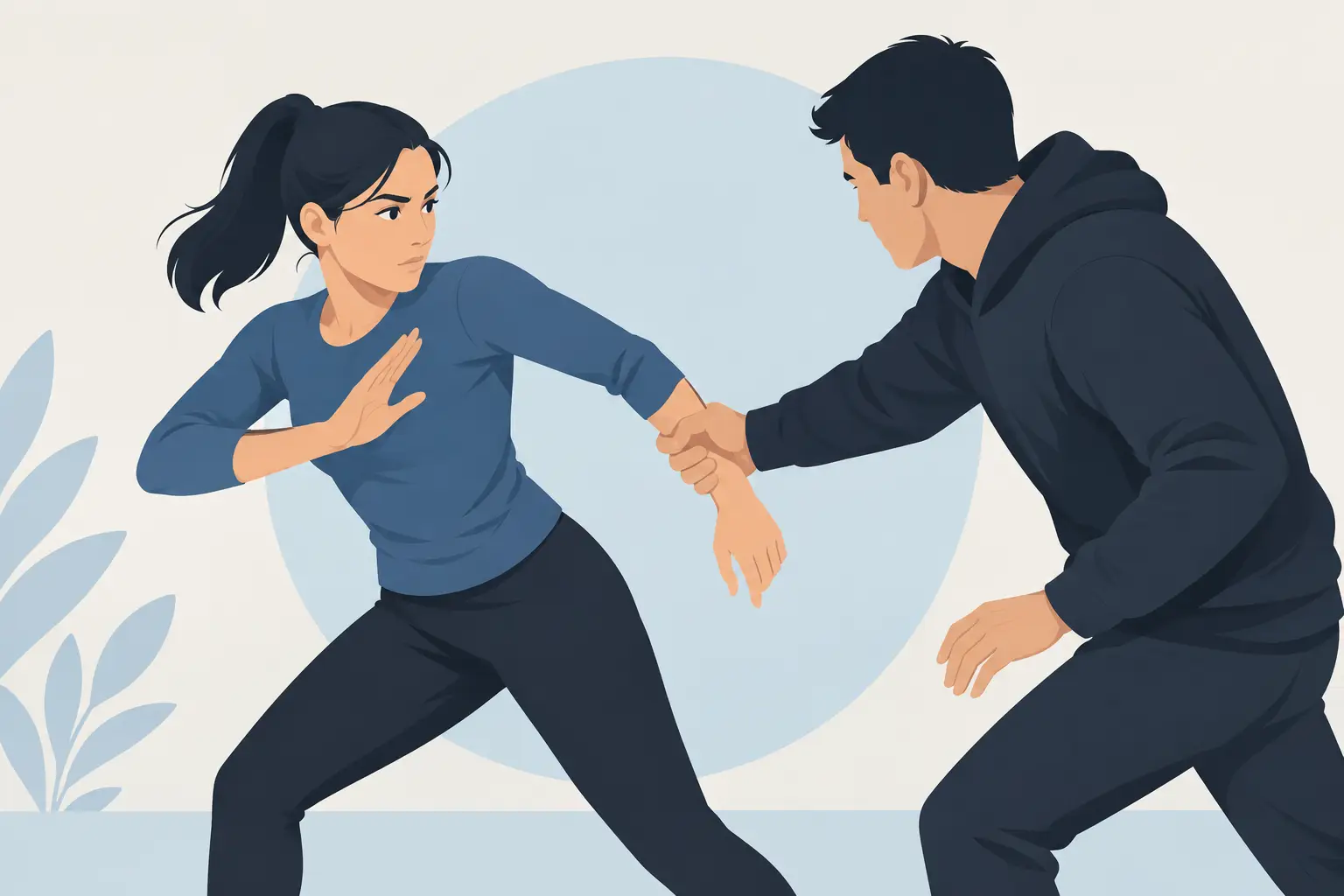
Start by keeping your feet under you rather than leaning backward and pulling with only your arm. If someone grabs your wrist, lower your center of gravity slightly by bending your knees. Keep your free hand up near your chest or face to protect yourself and maintain awareness of the person in front of you.
Your first instinct may be to yank your wrist directly away from the grab. That often turns into a strength contest, especially if the other person has a larger hand, stronger grip, or both hands on you. Instead, use your body to move toward the opening in their grip while stepping away from danger.
A wrist grab should also be treated as a warning sign. In a real situation, escaping the hold is not the finish line. You need to scan your surroundings, move toward people or a safe location, use your voice, and contact a trusted adult or emergency services if there is an immediate threat.
Find the Weak Point: The Thumb
The strongest part of a grip is usually where the fingers wrap tightly around the wrist. The weak point is commonly the space between the grabber’s thumb and fingers. That is where an escape has the best chance of working.
If someone grabs one wrist with one hand, turn your wrist so the narrow side of your hand, often called the “blade” side near the thumb, points toward the opening by their thumb. Then step back or angle your body away as you pull your hand through that opening.
This is not a wild, circular motion. It is a direct movement with a purpose. Turn, step, pull free, and move away. Using a step makes the escape stronger because your legs and hips contribute to the motion instead of leaving your smaller wrist and forearm to do all the work.
The direction may change depending on how the wrist is held. If the grabber’s thumb is on top, rotate toward the thumb gap. If their hand is turned differently, adjust your angle. Self-defense is not a magic move that works identically every time. Good training teaches students to recognize pressure, balance, and available space.
Use your voice while you move
A clear, strong command can draw attention and set a boundary. Say, “Let go!” or “Stop!” in a voice that is loud enough for people nearby to hear. Avoid arguing, explaining, or trying to negotiate during the escape. Your words should support your movement, not replace it.
For young students, practicing a strong voice is just as valuable as practicing the release itself. Children are often taught to be polite, but they need to understand that it is okay to be loud and firm when someone will not let them go.
Escaping Common Wrist Grab Situations
A simple one-hand grab is the best place to begin, but the situation can become more complicated. The principles remain consistent: protect your balance, move toward the weak point, use your whole body, and leave.
When someone grabs one wrist with one hand
Turn your wrist toward the thumb opening, take a step away, and pull your arm free in one decisive motion. Keep your elbow slightly bent instead of locking it. A bent arm gives you more structure and helps you move your body rather than just your hand.
Once free, do not stay close to demonstrate that the technique worked. Create distance immediately. Put your hands up in a protective position and move toward safety.
When someone grabs both wrists
Two-hand control can feel intimidating, but panic makes it harder to move. Bring your hands together if possible, orient them toward one thumb opening, and use a strong step or body turn to pull free. You are looking to escape one side of the grip, not pull evenly against both hands.
If your wrists are held low, avoid bending forward at the waist. Keep your posture upright and your eyes on the person. If your wrists are held high, move your feet and turn your body rather than simply pulling downward.
When a wrist grab becomes a pull
If someone pulls you toward them, do not automatically resist by leaning backward. That can pull you off balance. Step in the direction that helps you stabilize, then angle out toward the side of the thumb opening as you release.
This may sound counterintuitive, which is why supervised practice matters. Moving briefly with the pressure can help you regain balance and create the angle needed to break free. The objective is still escape, not staying in range to continue the conflict.
What Not to Do During a Wrist Grab
A few common reactions make escapes less effective. Do not depend on squeezing the attacker’s hand, twisting individual fingers, or trying to strike when you have a clear path to run. Those choices can fail under stress and may escalate an already dangerous situation.
Do not assume that one practiced movement solves every problem. Clothing, size differences, walls, uneven ground, multiple people, and surprise all change what is available. If you cannot break the grip immediately, protect your head, keep moving your feet, use your voice, and look for a chance to get away.
Students should also avoid practicing hard wrist releases casually with friends or siblings. A wrist can be injured when techniques are rushed, resisted too aggressively, or performed without instruction. Controlled drills build skill. Rough play builds bad habits.
Why Repetition Builds Real Confidence
Under stress, people often revert to what they have practiced. That is why self-defense training should include repeated, realistic, age-appropriate drills instead of a single demonstration. Students need to feel what a grab is like, learn how to stay composed, and practice moving away after the release.
At Japanese Martial Arts Academy, wrist-grab defenses can be developed through structured Japanese Jujutsu training alongside stand-up skills, awareness, balance, and controlled ground-fighting fundamentals. Students do not need previous martial arts experience to begin. They need a safe place to practice, qualified instruction, and a willingness to improve one repetition at a time.
For parents, this training offers more than a physical technique. Children learn personal boundaries, stronger communication, body awareness, and the confidence to act when something feels wrong. Teens gain practical skills without being encouraged to seek fights. Adults build fitness and calm decision-making that can carry into work, family life, and daily routines.
Practice for Escape, Not for a Fight
The best self-defense outcome is getting home safely. That mindset changes how you train. Rather than trying to prove who is stronger, you learn to identify danger early, set a firm boundary, break contact, and leave.
Practice slowly at first with a trusted partner. Begin with light, predictable grabs so you can learn the angle of the thumb opening and coordinate your footwork. As your control improves, training can become more realistic without becoming reckless. A qualified instructor can correct posture, timing, and safety habits that are easy to miss when practicing alone.
Confidence does not come from believing danger will never happen. It comes from knowing you have a plan: stay balanced, use your voice, escape the grip, and move toward safety. That calm, disciplined response is a skill worth building for every member of the family.