
Dojo Program Review for Parents and Adults
A dojo program review should answer more than one question: “Will this class be fun?” For a parent, the better question is whether a program will help a child build confidence, focus, respect, and real physical skills over time. For teens and adults, it should reveal whether training offers practical self-defense, meaningful fitness, and a disciplined path that keeps them motivated long after the first few classes.
The right dojo does not simply keep students busy. It provides structure, clear standards, qualified instruction, and a supportive training culture where each student can make visible progress. That matters whether your family is trying martial arts for the first time or searching for a more complete program than a single-style school can provide.
What a Strong Dojo Program Should Deliver
A quality martial arts program has a purpose behind every class. Students should know what they are practicing, why it matters, and how it connects to the next level of training. Younger students may learn this through simple goals such as maintaining a strong stance, following directions the first time, or showing respect to training partners. Older students can connect those same lessons to self-defense decision-making, fitness, and technical control.
Look for a curriculum that progresses in stages rather than repeating random drills each week. Rank requirements, skill benchmarks, and age-appropriate goals give students a reason to stay committed. They also help parents see that advancement is earned through attendance, effort, character, and demonstrated ability – not simply time spent paying for classes.
A well-run program also balances challenge with encouragement. Martial arts should ask students to work hard. It should not make beginners feel out of place because they do not already know the terminology or have athletic experience. The best instructors set high expectations while giving students the coaching and repetition needed to meet them.
Dojo Program Review: Training Beyond One Range
One of the most useful questions in a dojo program review is simple: What can students actually practice? Some schools specialize deeply in one area, which may be the right fit for a student with a very specific goal. A traditional striking program, for example, can build excellent timing, coordination, conditioning, and discipline.
For families and adults seeking broader self-defense preparation, however, a program that addresses more than one range of conflict can offer greater value. Stand-up skills teach students how to manage distance, move with balance, strike with control, and avoid being an easy target. Ground-fighting skills teach students what to do when distance disappears, including how to fall safely, escape holds, control a position, and remain calm under pressure.
This does not mean every student needs to train every discipline at once. Younger children especially need instruction that is clear, safe, and appropriate for their stage of development. It does mean the academy should have a thoughtful answer for both standing and close-contact situations. A dual-system approach gives students a more complete foundation while keeping training engaging over the years.
At Japanese Martial Arts Academy, this kind of breadth can include Japanese Goju-ryu Karate, Japanese Jujutsu, wrestling, Iaido, Kenjutsu, Ninjutsu, and specialty options such as Lightsaber training. The benefit is not collecting styles for the sake of it. It is giving students meaningful ways to develop coordination, awareness, confidence, and practical ability as their interests grow.
Safety Is Part of Serious Training
Martial arts training should be energetic, but safety must never be treated as optional. A reputable dojo has clear procedures for warmups, partner drills, supervision, hygiene, equipment, and behavior. Instructors should be present and attentive, not standing aside while students work through techniques that they have not been prepared to perform.
For children, safety also includes emotional security. A student should be corrected firmly but respectfully. The goal is to develop resilience, not embarrassment. Watch how instructors respond when a child loses focus, gets frustrated, or makes a mistake. Their response tells you much more about the school than a polished sales pitch.
Adults should expect the same professional standard. Training partners may differ in size, age, and experience, so controlled practice matters. Good programs teach students how to apply technique with care, tap or signal when needed, and respect physical limits. Hard training has a place, but it should be built on sound fundamentals and mutual trust.
Character Development Should Be Visible
Parents often enroll children in martial arts because they want help with confidence, discipline, and self-control. Those benefits are real when character development is part of the instruction, not just a slogan on the wall.
Listen for instructors reinforcing habits such as attention, perseverance, courtesy, responsibility, and calm behavior. Notice whether students are expected to line up properly, care for their uniforms, listen during instruction, and treat classmates with respect. Small standards repeated consistently become habits that carry into school, home, and friendships.
Confidence deserves special attention. True confidence is not loudness or aggression. It comes from learning to do difficult things, receiving correction without quitting, and seeing steady improvement through effort. A child who once avoided eye contact or hesitated to participate may gradually stand taller, speak more clearly, and approach challenges with a different mindset. That progress is worth far more than a quick belt promotion.
The Best Program Depends on the Student
There is no single perfect dojo for every person. A shy six-year-old, a competitive teenager, a parent returning to fitness, and an adult focused on personal protection may all need something different from their training experience.
For younger children, prioritize patient instruction, clear routines, positive accountability, and classes that keep them moving without becoming chaotic. For teens, look for a program that provides a positive peer group and a demanding outlet for energy. Martial arts can give teens a place to build leadership, physical confidence, and self-control away from screen-heavy routines.
Adults may care most about fitness, stress relief, self-defense, or reconnecting with a personal goal. The strongest adult programs welcome beginners without watering down the training. You should be able to start at your current level, improve conditioning, learn practical skills, and train alongside people who take progress seriously.
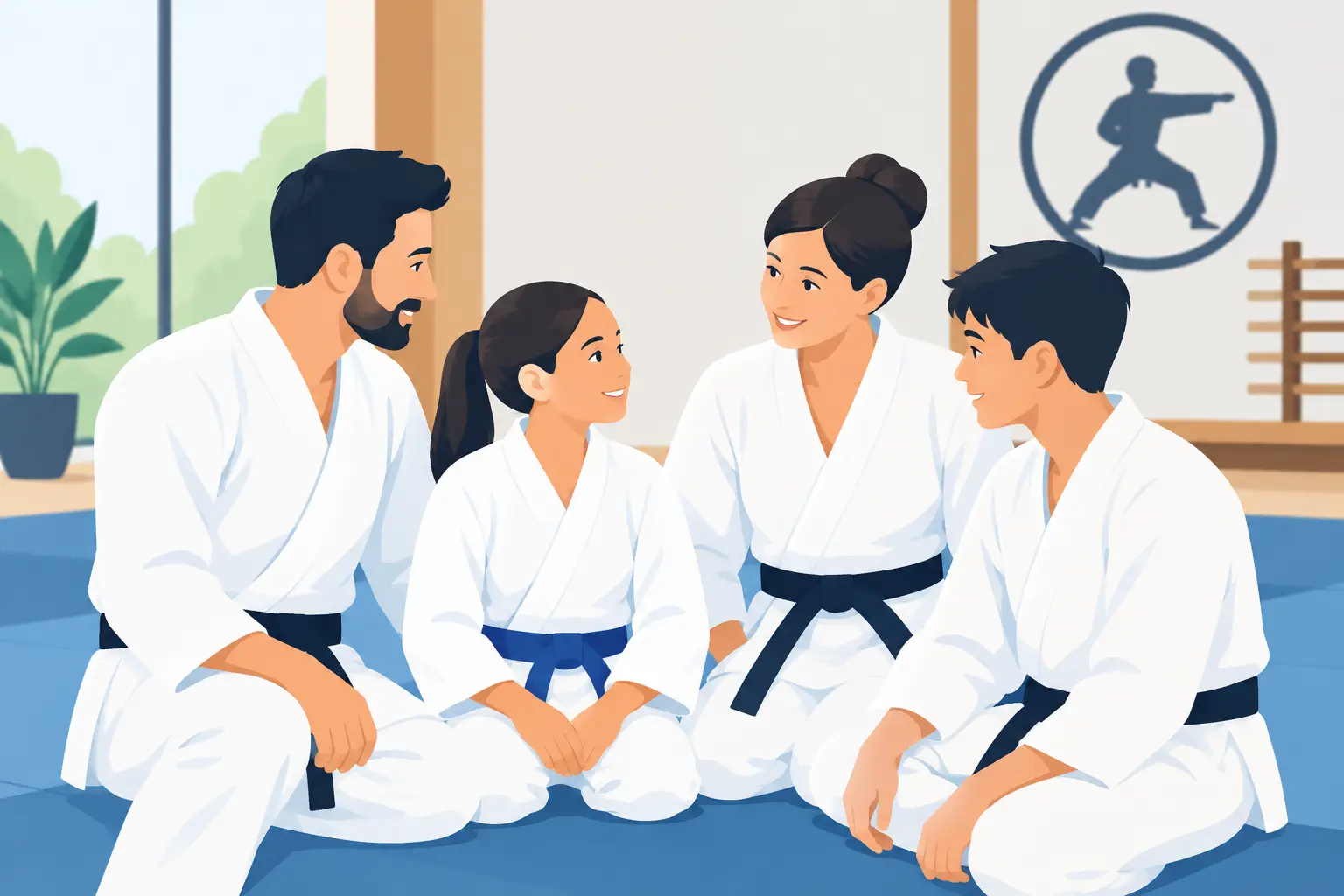
Family programming is another important consideration. When parents and children train in the same academy, martial arts can become a shared commitment rather than another item on the weekly schedule. Families gain common language around discipline and goals, celebrate promotions together, and support one another through the hard parts of learning.
Questions to Ask Before You Enroll
Before choosing a dojo, visit a class and pay attention to what happens on the floor. You do not need to be a martial arts expert to spot the signs of thoughtful instruction. Ask how beginners are introduced, how students advance, and what skills each age group will work toward.
It is also reasonable to ask about instructor experience, class size, safety policies, and the balance between traditional training and practical application. If self-defense is a priority, ask how the curriculum addresses awareness, distance, escapes, and ground situations. If your child needs help with focus or behavior, ask how instructors reinforce expectations during class.
Finally, observe the students. Are they engaged? Do they respond to instruction? Are advanced students helpful without acting superior? A healthy dojo community has standards, but it also has patience. Students should feel challenged to improve and secure enough to keep showing up.
Start With a Real Class Experience
A conversation can explain a curriculum, but an introductory class reveals how a program feels. It lets your child experience the routine, meet the instructors, and see whether the environment is a good match. Adults can test their current fitness level without pressure and learn what beginner training actually involves.
Use that first experience to focus on fit rather than perfection. No one needs to be flexible, tough, or experienced on day one. The important question is whether the dojo gives your family a disciplined place to grow, one class at a time. Choose a program where effort is noticed, standards are clear, and every student has room to become stronger.