
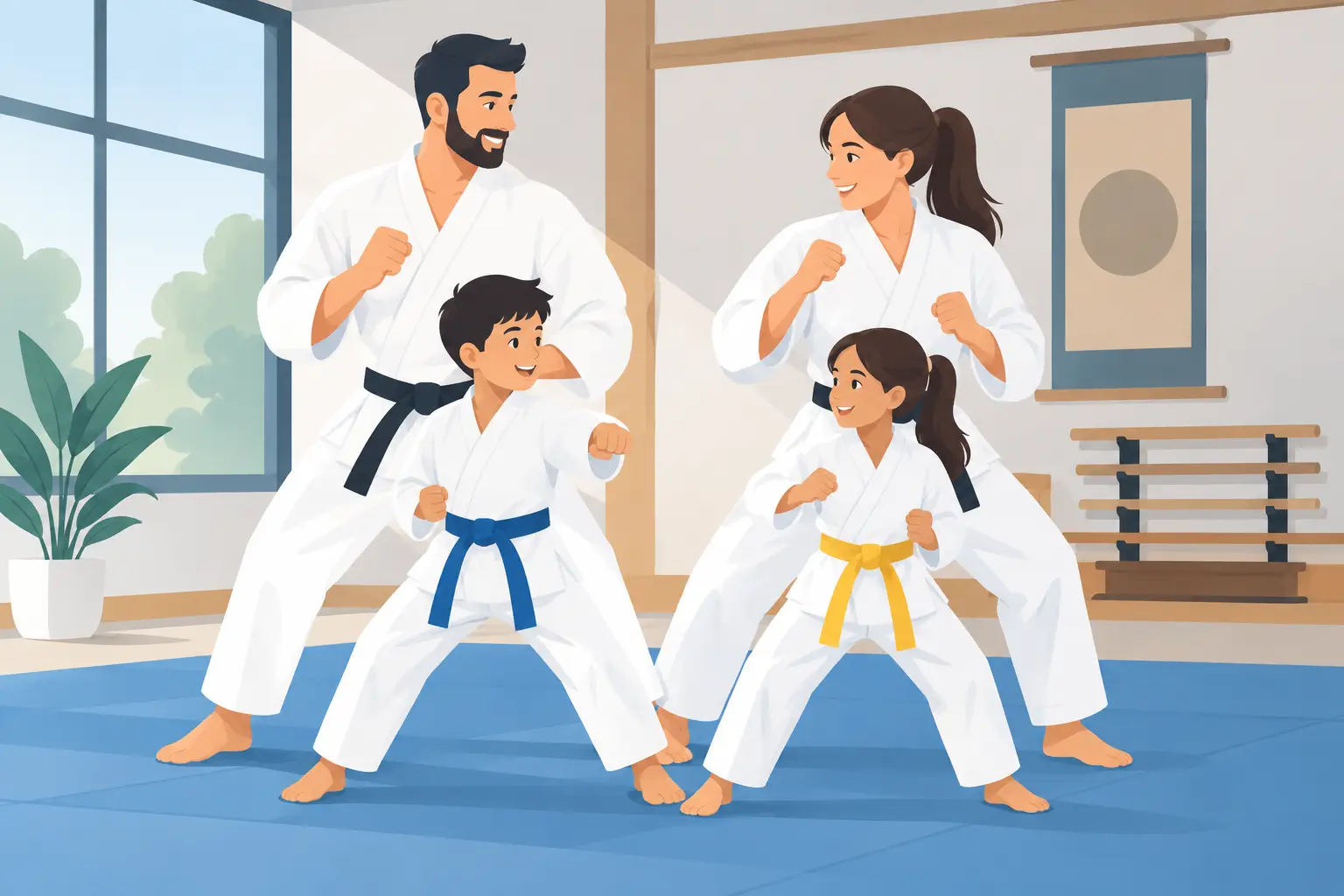
A Practical Guide to Family Dojo Participation
A family’s first night at the dojo can change the rhythm of the whole week. Instead of another evening split between screens, rushed meals, and separate activities, everyone has a shared place to move, learn, and grow. This guide to family dojo participation will help you begin with clear expectations and build a routine that supports every member of your household.
Family training is not about asking every person to perform at the same level. It is about showing up with a willingness to learn, respecting the mat, and encouraging one another through the hard parts. A young child may be working on focus and listening skills while a parent is improving fitness and practical self-defense. Both are making progress, and both deserve to feel it.
Why Family Dojo Participation Builds Stronger Habits
Martial arts provide structure that families can feel outside the dojo. Students bow in, pay attention, practice with control, and keep trying when a technique does not work right away. Those lessons carry into schoolwork, chores, conversations, and personal goals.
For children, training offers a positive outlet for energy while building confidence, coordination, self-control, and respect. They learn that confidence is not being the loudest person in the room. It comes from practicing, improving, and handling challenges with composure.
Parents and teens gain something equally valuable: a demanding but supportive way to improve strength, conditioning, awareness, and stress management. Traditional striking, grappling, and self-defense training ask the mind to stay present. You cannot worry about tomorrow’s schedule when you are learning a stance, practicing a breakfall, or working through a controlled drill with a partner.
The family benefit is accountability. It is easier to skip a workout when no one notices. It is harder when your child has packed their uniform, your spouse is ready to go, and the dojo has become part of the family calendar. That shared commitment creates momentum.
Start With the Right Expectations
The best first step is to let go of the idea that you need to arrive in shape, coordinated, or knowledgeable. Beginners belong in beginner classes. A quality dojo should provide a clear path for new students, teach safety from the first class, and give each person room to progress at an appropriate pace.
Before attending, talk as a family about why you are training. A child may want to feel braver at school. A teen may want a physical challenge beyond a screen-heavy routine. An adult may be focused on self-defense, fitness, or finally committing to a personal goal. Those reasons can be different, but stating them helps everyone stay connected to their purpose when training becomes difficult.
It also helps to set a realistic schedule. Two consistent classes each week often create better results than an ambitious schedule that falls apart after two weeks. Consider school demands, work shifts, transportation, and recovery time. The goal is not to fill every open hour. The goal is to create a routine your family can maintain.
Prepare for the First Class
Arrive a little early, wear comfortable workout clothing if a uniform has not been issued, and bring water. More importantly, arrive ready to listen. Martial arts training has traditions and etiquette for good reasons. They help create an organized environment where students can practice safely and give the instructor their full attention.
Tell children what to expect in simple terms. They may be asked to line up, follow instructions, work with partners, and repeat movements many times. Explain that mistakes are normal. The dojo is where mistakes become skills through patient repetition.
Your Guide to Family Dojo Participation in the First Month
The first month is about consistency, not perfection. Your family will be learning names, class routines, basic positions, and the physical demands of training. Some classes will feel energizing. Others may feel awkward or tiring. That is normal progress at work.
During the first week, focus on attendance and observation. Learn where to stand, how class begins and ends, and what your instructors expect from students. Encourage children to watch carefully rather than rushing to be first. Attention is a martial arts skill.
By the second and third weeks, students often begin to recognize familiar movements. This is where families should praise effort rather than talent. Say, “You kept practicing that even when it was hard,” instead of, “You are naturally good at this.” Effort-based encouragement teaches children and adults alike that improvement is earned.
At home, keep conversations short and positive. Ask what they practiced, what felt challenging, or what they would like to improve next class. Avoid turning the living room into an extra class. A few minutes of relaxed practice can help, but rest, family time, and unstructured play matter too.
By week four, review the routine together. Is the class time working? Does everyone have the gear they need? Is one family member feeling discouraged or overwhelmed? Small adjustments early on can protect the habit before schedules become a reason to stop.
Progress will not look identical for everyone. A child may earn confidence before they earn a new rank. An adult may notice better balance and energy before seeing major changes in strength or endurance. Training rewards patience, and the results often show up in everyday life before students realize how far they have come.
Support Your Student Without Becoming Their Coach
Parents play a powerful role in a child’s martial arts experience, but the instructor should remain the instructor. Your job is to provide transportation, encouragement, preparation, and calm support. Let the dojo handle technical correction and rank requirements.
After a tough class, resist the urge to immediately solve every frustration. If your child says a drill was hard or another student seemed better, listen first. Remind them that every experienced martial artist began as a beginner. Then help them identify one small goal for the next class, such as remembering a stance, speaking louder, or staying focused through warm-ups.
The same principle applies when family members train together. Do not compare a younger sibling’s progress with an older sibling’s, or a beginner parent’s flexibility with a teen athlete’s. Comparison drains confidence. Respectful encouragement builds it.
A good family dojo culture makes room for serious training and good humor. Celebrate effort, show respect to training partners, and treat setbacks as part of the process. The strongest students are not always the ones who learn fastest. They are often the ones who return after a difficult day.
Training Together When Ages and Goals Differ
Families do not need identical goals to benefit from the same academy. A younger child may thrive in a program built around focus, coordination, and character. A teen may want practical self-defense and a more demanding physical challenge. Adults may be drawn to Japanese Goju-ryu Karate, Japanese Jujutsu, Iaido, wrestling, or another discipline that fits their interests.
This variety is a strength when the academy has a thoughtful curriculum. Students can develop stand-up skills and ground-fighting awareness rather than relying on one narrow approach. They can also find a program that keeps them motivated long enough to build real competence.
At Japanese Martial Arts Academy, families can train within a community that respects traditional Japanese systems while welcoming complete beginners. The important question is not whether everyone takes the exact same class. It is whether each family member has a structured path, capable instruction, and a reason to keep coming back.
Choose Commitment Over Pressure
There will be busy weeks, tired evenings, school events, and moments when motivation drops. That does not mean the routine has failed. It means your family is living a full life. Return to the next class, reset the schedule, and keep the standard simple: show up prepared to learn.
A dojo becomes meaningful when it is more than an activity on the calendar. It becomes a place where your child learns to stand taller, your teen learns to handle pressure, and you prove to yourself that growth still has a place in a busy adult life. Start with one class, support each other through the first month, and let disciplined training become one of the strongest habits your family shares.