
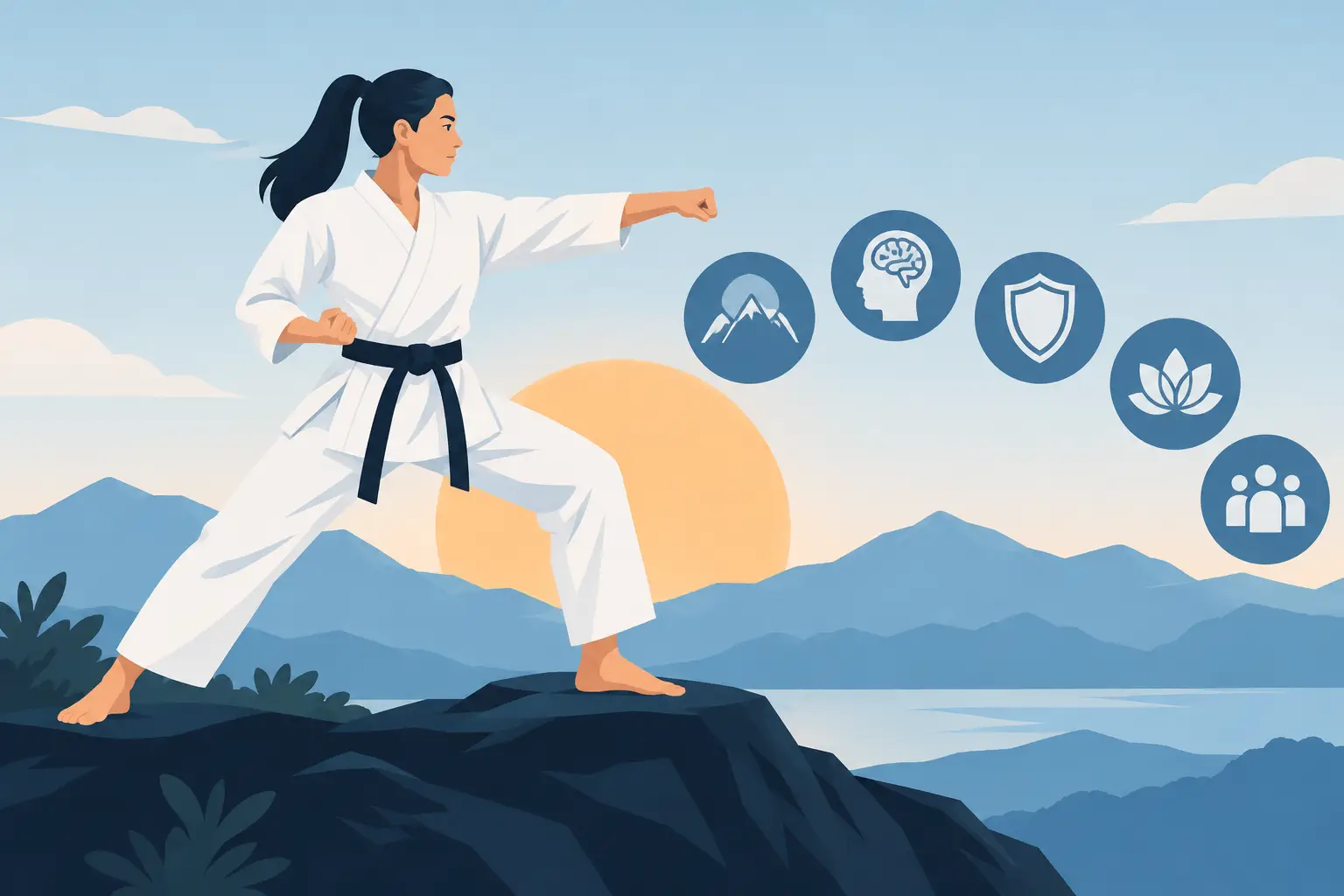
Five Ways Karate Builds Resilience for Life
A child misses a block during partner drills, resets their stance, and tries again. A teen struggles through conditioning but finishes the final round. An adult walks into class after a difficult workday and chooses focused practice over staying on the couch. These are the everyday moments behind five ways karate builds resilience. Resilience is not a speech, a slogan, or a personality trait that some people simply have. It is the ability to respond to pressure, setbacks, and discomfort with composure and forward action.
For families, that skill matters far beyond the dojo floor. Children need it when schoolwork gets harder, friendships become complicated, or a new responsibility feels intimidating. Teens need it when confidence is tested and expectations rise. Adults need it when work, family obligations, fitness goals, and daily stress compete for attention. Traditional karate gives students a structured place to practice meeting challenges without quitting.
Five Ways Karate Builds Resilience Through Practice
1. It teaches students to recover after mistakes
Karate is precise. A stance can be too narrow, a guard can drop, a technique can lose balance, or a sequence can be forgotten. Students receive correction, make an adjustment, and repeat the movement. This cycle happens hundreds of times over the course of training.
That process changes how students view mistakes. Instead of treating an error as proof that they are not good enough, they learn to see it as information. The instructor identifies what needs work, the student applies the correction, and the result improves through effort. For a child who is afraid to get an answer wrong in class, or an adult who avoids new challenges because they dislike being a beginner, that is a powerful lesson.
The goal is not perfection on the first attempt. The goal is the discipline to reset quickly. A student who can say, “I missed that technique, but I know what to work on,” is developing a mindset that carries into school, careers, and relationships.
2. It builds confidence through earned progress
Real confidence is not loud. It comes from knowing you can follow through when something is difficult. Karate develops that confidence through visible, earned progress: stronger technique, better balance, improved endurance, new forms, practical self-defense skills, and eventually advancement in rank.
A belt should never be treated as a shortcut to confidence. It represents consistent attendance, attention to detail, effort, and growth over time. That matters because students learn that progress is not always fast. Some techniques feel natural immediately, while others require weeks of patient practice.
This is especially valuable for young students. Many children are used to quick entertainment and instant feedback. Karate asks them to stay with a challenge long enough to improve. When they finally perform a difficult combination correctly or demonstrate a form with focus, the pride is different. They did not receive it automatically. They built it.
For adults, the same principle applies. Fitness improvements, better mobility, and sharper self-defense skills develop one class at a time. The work is demanding, but the results are real. That steady progress can help students feel more capable in every area of life.
3. It creates healthy exposure to pressure
Resilience does not mean never feeling nervous. It means learning how to function well while nervous. Karate provides safe, supervised opportunities to experience pressure and respond with control.
A student may feel pressure while performing in front of the class, testing for a new rank, working with a partner, or completing conditioning at the end of training. These moments can be uncomfortable, particularly for beginners. Yet they take place in a structured environment where instructors set clear expectations and help students build skills at an appropriate pace.
Over time, students learn practical ways to manage that feeling. They breathe, focus on their next instruction, maintain their stance, and keep moving. Rather than becoming overwhelmed by a large challenge, they break it into the next useful action.
There is an important distinction here. Productive pressure builds students up; unsafe or humiliating pressure does not. Quality instruction challenges each person while respecting their age, experience, physical condition, and current ability. A six-year-old beginner and an experienced adult do not need the same type of challenge, but both benefit from learning they can remain calm and capable when the stakes feel higher.
4. It develops discipline when motivation fades
Motivation is helpful, but it is not dependable. Some days students are excited to train. Other days they are tired, frustrated, busy, or simply not in the mood. Resilience grows when students learn the difference between how they feel in the moment and what they choose to do next.
Karate class gives that lesson a routine. Students arrive, prepare their uniform, line up, listen, practice, and finish with respect. Those repeated actions create habits of responsibility. Parents often notice the effect at home as children become more responsive to routines, more willing to complete tasks, and better able to focus before moving on to the next activity.
Discipline is not punishment. It is the ability to direct your effort toward what matters. In training, that may mean practicing a basic stance even when a student would rather work on a more exciting technique. At home, it may mean finishing homework before screen time. For adults, it may mean protecting time for health and personal growth even during a busy week.
Students do not have to enjoy every difficult repetition for it to help them. They simply need to learn that discomfort is not a stop sign. Sometimes it is evidence that they are doing meaningful work.
5. It gives students a community that expects them to grow
Resilience is often described as an individual quality, but people build it more effectively when they are not alone. In a karate class, students train alongside people who are also working through challenges. They see beginners take their first steps, experienced students refine advanced skills, and families support one another through milestones.
That community provides accountability. When students know their instructor and training partners expect to see them, it is easier to return after a tough class or a missed week. They also learn respect for different abilities and stages of progress. A strong student can encourage a newer partner. A newer student can learn that everyone once struggled with the basics.
At Japanese Martial Arts Academy, this supportive structure is part of the value of multigenerational training. Children, teens, and adults can pursue meaningful goals in an environment built on tradition, expert guidance, and mutual respect. Families do not just watch growth happen from the sidelines. They can share in it.
Resilience Looks Different at Every Age
For children, resilience may look like raising a hand after getting an answer wrong, trying a new activity without a parent beside them, or staying composed after losing a game. Karate helps by giving them clear rules, consistent coaching, and small victories they can recognize.
For teens, resilience often involves self-control and identity. Teenagers face academic demands, social pressure, and constant comparison. Training gives them a place where effort matters more than appearance and where confidence comes from demonstrated skill. It can also provide a constructive outlet for stress, restless energy, and frustration.
For adults, resilience may mean rebuilding fitness after years away from exercise, learning practical self-defense, or creating a disciplined routine that supports mental focus. The physical challenge is valuable, but so is the chance to put daily worries aside and concentrate fully on the task in front of you.
Results depend on consistency. Training once will not erase every fear or solve every difficult situation. Some students need more time than others to feel comfortable with partner work, public performance, or physical conditioning. What karate offers is a proven process: show up, practice with purpose, accept coaching, and continue.
The next time a challenge makes you or your child want to step back, consider the lesson practiced on the dojo floor: settle your stance, focus on the next movement, and take one disciplined step forward.