
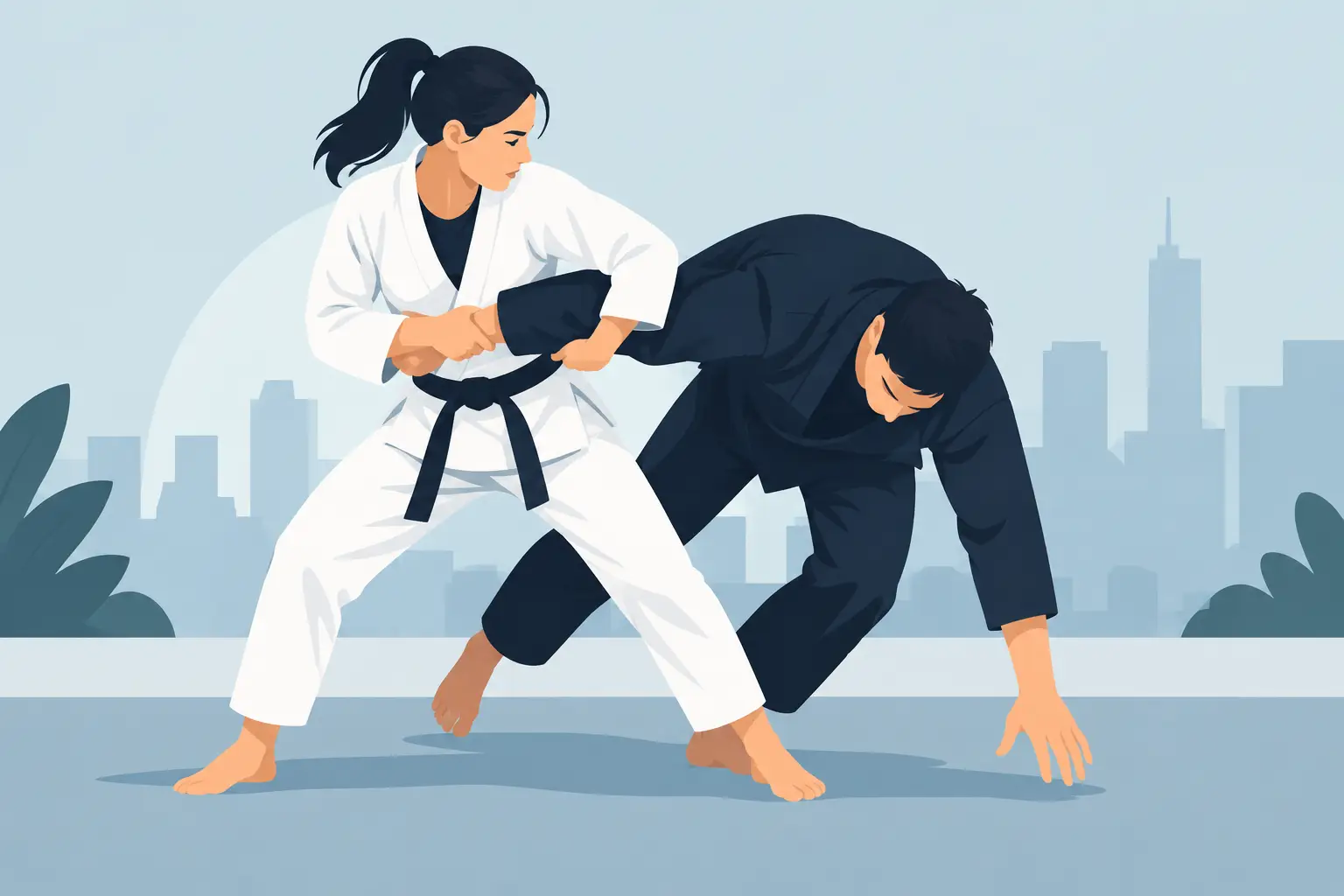
Is Jujutsu Effective for Real-World Self-Defense?
A larger, stronger person has grabbed your wrist, crowded your space, or forced you to the ground. In that moment, flashy kicks and complicated moves are not the answer. The real question is: is jujutsu effective when a situation becomes physical? With consistent, well-coached training, Japanese Jujutsu can be a highly effective system for self-defense, control, confidence, and physical readiness.
Its value does not come from learning a long list of techniques. It comes from practicing how to manage distance, break balance, protect yourself during a fall, escape holds, and regain control under pressure. For children, teens, and adults, those skills can create a stronger foundation both on and off the mat.
What Makes Jujutsu Effective?
Japanese Jujutsu was developed around a practical problem: how can a person defend themselves when an opponent is close, grabbing, pushing, or trying to take them down? Rather than relying only on striking power, jujutsu teaches students to use body positioning, leverage, timing, and control.
That makes it especially valuable at close range. Many real confrontations do not begin with a clean fighting stance. They begin with someone grabbing clothing, holding an arm, shoving, or invading personal space. Jujutsu gives students structured answers to these common situations.
A quality program teaches students how to stay balanced, move safely, and avoid panic. They learn that effective self-defense is not about proving who is tougher. It is about recognizing danger early, creating an opportunity to get away, and using only the force necessary to protect yourself or someone else.
Leverage Changes the Equation
Jujutsu does not pretend that size and strength do not matter. They do. A bigger, stronger person has real physical advantages. But leverage can reduce that advantage by teaching a smaller defender to work with joints, angles, momentum, and balance instead of trying to overpower someone head-on.
For example, a student may learn to turn their body rather than pull directly against a grip, or to redirect a push instead of meeting it with force. These principles are useful because they are based on sound movement, not athletic talent alone. Still, they require repetition. A technique seen once is not a dependable skill. A technique practiced carefully over time becomes more natural when stress rises.
Ground Skills Matter
A confrontation that reaches the ground changes quickly. Someone who has never practiced falling may be injured before they can even think about defending themselves. Someone who has never dealt with a pin or grab may freeze.
Jujutsu training addresses this gap with breakfalls, escapes, holds, and positional control. Students learn how to protect their head and body during a fall, how to move from a disadvantaged position, and how to create enough space to stand up safely. This is one reason a dual focus on stand-up defense and ground fighting is so valuable for practical training.
Is Jujutsu Effective for Self-Defense Outside the Dojo?
Yes, but effectiveness depends on how it is taught and practiced. A self-defense system works best when training includes realistic movement, controlled resistance, awareness, and clear judgment about when not to fight.
At its best, jujutsu teaches students to avoid unnecessary conflict. Walking away, using a strong voice, staying aware of surroundings, and getting help are often the safest choices. Physical techniques are for situations where avoidance is no longer possible.
The most useful jujutsu training also avoids giving students false confidence. No martial art makes a person invincible. Multiple attackers, weapons, confined spaces, surprise, and legal consequences all change the situation. Good instruction prepares students to stay calm and make better decisions, not to seek danger.
Pressure Testing Is Part of the Answer
Cooperative drills are important when students are learning mechanics safely. A partner gives a specific grip, the student practices a response, and both people build correct movement. But training should not stop there.
As students progress, they need opportunities to work with increasing resistance and unpredictability. That may include controlled grip fighting, escape drills, balance challenges, and supervised sparring or scenario work. This helps students discover what holds up when a partner is actively trying to maintain a position.
The goal is not to turn every class into a brawl. The goal is to make technique honest. A student who can stay composed, protect their balance, and apply a simple escape against resistance is building a skill that has practical value.
Benefits for Children and Teens
For young students, the most immediate benefit of jujutsu is often not fighting ability. It is self-control. Children learn to listen, follow directions, respect training partners, and manage their emotions when something feels difficult.
Jujutsu also teaches body awareness. A child who knows how to fall safely, maintain balance, and use appropriate personal space may be better prepared for everyday rough-and-tumble moments as well as organized sports. They gain confidence from visible progress: a skill that was awkward in the first week becomes smoother after steady practice.
For teens, the training can provide a positive outlet during years when confidence, social pressure, and screen-heavy routines often collide. The mat creates a place where effort matters. Students are challenged, held accountable, and supported by teammates who are working toward their own goals.
Parents should look for an academy that keeps youth training age-appropriate. Children do not need adult-level force or fear-based instruction. They need clear boundaries, excellent supervision, and a culture where respect is expected. The right program helps them become more confident without becoming reckless.
Benefits for Adults: Fitness With a Purpose
Adults often come to jujutsu for self-defense, but they stay because the training is engaging. Drilling throws, escapes, movement patterns, and ground positions develops coordination, mobility, grip strength, core stability, and conditioning. Unlike a workout that asks you to repeat the same motion on a machine, martial arts demands attention.
That mental focus can be just as valuable as the physical work. You are solving problems while moving, adapting to a partner, and learning to remain composed when tired. Over time, many adults notice that the discipline built in class carries into work, parenting, and daily routines.
Beginners do not need to arrive in peak condition. They need a program that meets them where they are and gives them room to progress. A responsible instructor can scale intensity, teach safe falling skills, and help students build confidence one step at a time.
Choosing a Jujutsu Program That Delivers Results
Not every class labeled “jujutsu” has the same focus. Some schools emphasize traditional forms and historical technique. Others focus more heavily on self-defense applications, sparring, or grappling. Tradition has real value, but students should understand what they are training for.
When evaluating a program, watch how instructors correct students. Do they explain why a movement works? Are beginners taught safety before speed? Do students practice against appropriate resistance? Is respect visible between children, teens, adults, and instructors?
A strong academy should also offer a path forward. A new student needs simple fundamentals. An experienced student needs deeper technical challenges, conditioning, and opportunities to test their skills responsibly. At Japanese Martial Arts Academy, students can develop both stand-up and ground skills within a structured traditional martial arts environment built for families and individual growth.
The Practice Behind Real Confidence
Jujutsu is effective because it rewards disciplined training, not because it promises a secret move. The most dependable skills are usually the least dramatic: a safe fall, a strong stance, a simple escape, a calm decision, and the ability to get home safely.
If you or your child wants to build confidence through practical, respectful training, begin with a class that emphasizes safety, repetition, and qualified instruction. Progress starts when you step onto the mat, stay open to learning, and give yourself time to grow.