
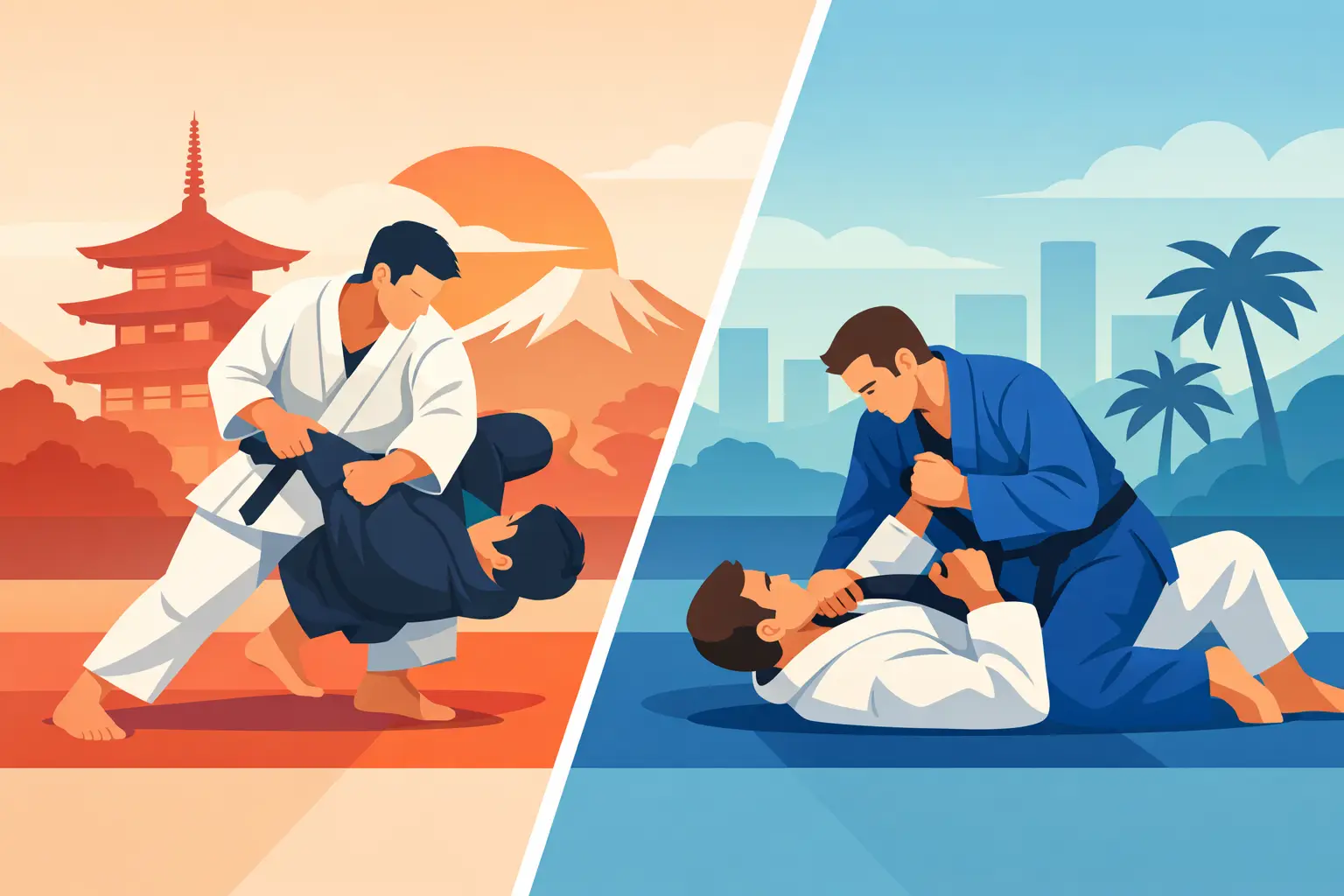
Japanese Jujutsu Versus BJJ: Which Fits You?
A disagreement, a grab, and very little space to move can change the value of martial arts training fast. Japanese jujutsu versus BJJ is not simply a question of old style versus new style. It is a question of what you want your training to prepare you to do: stay balanced, escape a hold, control an opponent on the ground, build confidence, or develop a complete set of skills over time.
Both systems can build fitness, discipline, resilience, and practical body awareness. Both require patience and consistent practice. Their priorities, however, are different enough that families and adult beginners should understand what they are stepping into before choosing a class.
What Is Japanese Jujutsu?
Japanese jujutsu is a broad family of traditional martial arts developed in Japan. Historically, its methods were shaped by the need to respond when striking, distance, or weapons were not the best option. Different schools teach different material, but Japanese jujutsu commonly includes standing escapes, joint controls, throws, sweeps, pins, breakfalls, strikes, and defenses against grabs.
The central idea is efficient control. Rather than trying to meet force with more force, students learn leverage, timing, posture, angles, and balance disruption. A smaller student may not overpower a larger person, but they can learn to recognize a wrist grab, create space, off-balance the other person, and move toward safety.
Traditional training also usually places strong value on etiquette and structure. Students practice with partners in a controlled setting, learn how to fall safely, and develop composure before speed. For children and teens, that structure can be just as valuable as the techniques. They are learning to listen, manage energy, respect training partners, and stay calm under pressure.
What Is BJJ?
Brazilian jiu-jitsu, usually called BJJ, is a grappling art best known for its highly developed ground-fighting system. BJJ focuses heavily on positional control, escapes, sweeps, submissions, and the ability to manage a resisting opponent after the fight has gone to the ground.
A typical BJJ class often includes technique instruction followed by live positional rounds or sparring, commonly called rolling. Students may practice escaping side control, passing guard, defending a choke, or using a sweep to reverse position. Because training often involves active resistance, BJJ gives students frequent feedback about what works when a partner is trying not to cooperate.
That pressure-testing is one of BJJ’s greatest strengths. It builds confidence in close contact and helps students become comfortable making decisions while tired. It can also be physically demanding. Beginners should expect a learning curve, especially when it comes to pacing, breathing, and learning how to train hard without treating every round like a competition.
Japanese Jujutsu Versus BJJ: The Biggest Differences
The clearest difference is where each system spends most of its time. Japanese jujutsu generally prepares students for a wider range of standing self-defense situations. BJJ generally goes deeper into what happens after both people are on the ground.
Japanese jujutsu may teach how to respond to a wrist grab, shirt grab, shove, or attempted hold while remaining on your feet. It may include throws and takedowns, but the goal is often to create control and an opportunity to disengage. BJJ also includes takedowns in many schools, yet its strongest technical emphasis is usually ground control once contact has been established.
Their training methods can feel different as well. Traditional Japanese jujutsu often begins with carefully structured repetitions. This helps students learn safe movement, correct mechanics, and responsible control of their partner. BJJ often moves more quickly toward resistance-based drilling and live rounds. Neither approach is automatically better. Structured practice builds reliable fundamentals, while resistance reveals gaps and sharpens timing.
There is also a difference in the role of striking. Many Japanese jujutsu programs include strikes as distractions, defensive tools, or part of a broader self-defense sequence. Most BJJ schools do not train striking as a central part of class. That does not make BJJ less effective at grappling. It simply means students seeking a stand-up self-defense system may want to pair it with striking and takedown training.
Which Style Is Better for Self-Defense?
For self-defense, context matters more than labels. A student who trains only ground fighting may become very capable on the mat but have fewer answers for managing distance, escaping before a takedown, or responding to a sudden grab while standing. A student who trains only compliant standing techniques may understand useful mechanics but need more experience against active resistance.
A balanced answer is that both can be valuable. Japanese jujutsu offers a broader traditional framework for standing defense, escapes, body positioning, and controlled restraint. BJJ provides exceptional skill in surviving, escaping, and controlling from difficult ground positions. The strongest preparation often combines stand-up awareness with serious ground-fighting ability.
That is why a dual-system approach matters. At Japanese Martial Arts Academy, students can develop standing skills through Japanese martial arts training while also building practical ground control through wrestling-based instruction. The result is not just a collection of moves. It is the ability to remain composed whether an encounter begins at arm’s length, in a clinch, or on the floor.
Real self-defense also includes judgment. The goal is not to win a dramatic fight. It is to recognize danger, use your voice, create distance, protect yourself or your family, and leave safely when possible. Physical skills support that goal, but awareness and self-control lead the way.
What Families Should Consider
Parents often ask which art will help their child build confidence without encouraging aggression. Either style can do that when it is taught by qualified instructors in a disciplined, age-appropriate environment. The key is not whether a child wears a traditional uniform or practices ground positions. The key is whether the class develops safe habits, respect, focus, and steady progress.
Japanese jujutsu can be an excellent fit for children who benefit from clear structure and a broad introduction to self-defense movement. Learning breakfalls, balance, controlled throws, and partner awareness can strengthen coordination while giving children a tangible sense of capability.
BJJ can be a strong choice for children who enjoy hands-on problem solving and active grappling. A child quickly learns that strength alone is not enough. They must use position, patience, and technique. That lesson often carries into school, sports, and daily challenges.
For families, look beyond the style name. Watch how instructors correct students. Notice whether training partners are taught to protect one another. Ask how beginners are introduced to contact and how progress is measured. A good program helps students feel challenged without feeling lost or unsafe.
What Adults Can Expect From Each
Adults who want practical self-defense often appreciate Japanese jujutsu because it connects technique to common standing situations. It can improve posture, balance, mobility, and the confidence to handle close-range contact without panic. Adults returning to exercise may also appreciate the progressive pace of learning forms, falls, holds, and throws.
Adults drawn to BJJ often enjoy the intensity of solving physical problems against resistance. It is a demanding workout that develops grip strength, core stability, conditioning, and mental toughness. The community can be especially motivating because every student remembers what it felt like to start from zero.
There are trade-offs. BJJ training can place regular stress on the neck, fingers, shoulders, and knees if a student trains carelessly or refuses to tap when caught. Japanese jujutsu includes throws, locks, and falls that also require responsible instruction and controlled partners. In either system, good coaching, gradual progression, and honest communication about injuries make a major difference.
Do You Have to Choose Only One?
Not necessarily. Many serious martial artists eventually cross-train because each discipline exposes a different part of the puzzle. Japanese jujutsu can improve your ability to stay mobile, break balance, and respond before a fight becomes a ground battle. BJJ can make you far more capable if you are taken down or need to control someone without striking them.
For a beginner, the best first choice is often the program you will attend consistently. A welcoming school, capable instructors, safe training culture, and classes that match your goals matter more than chasing the perfect label. Consistent training transforms uncertainty into useful skill.
Try to choose training that makes you more prepared, more disciplined, and more considerate of the people around you. Whether your first class begins with a breakfall or a guard escape, the right instruction should leave you standing a little taller in everyday life.