
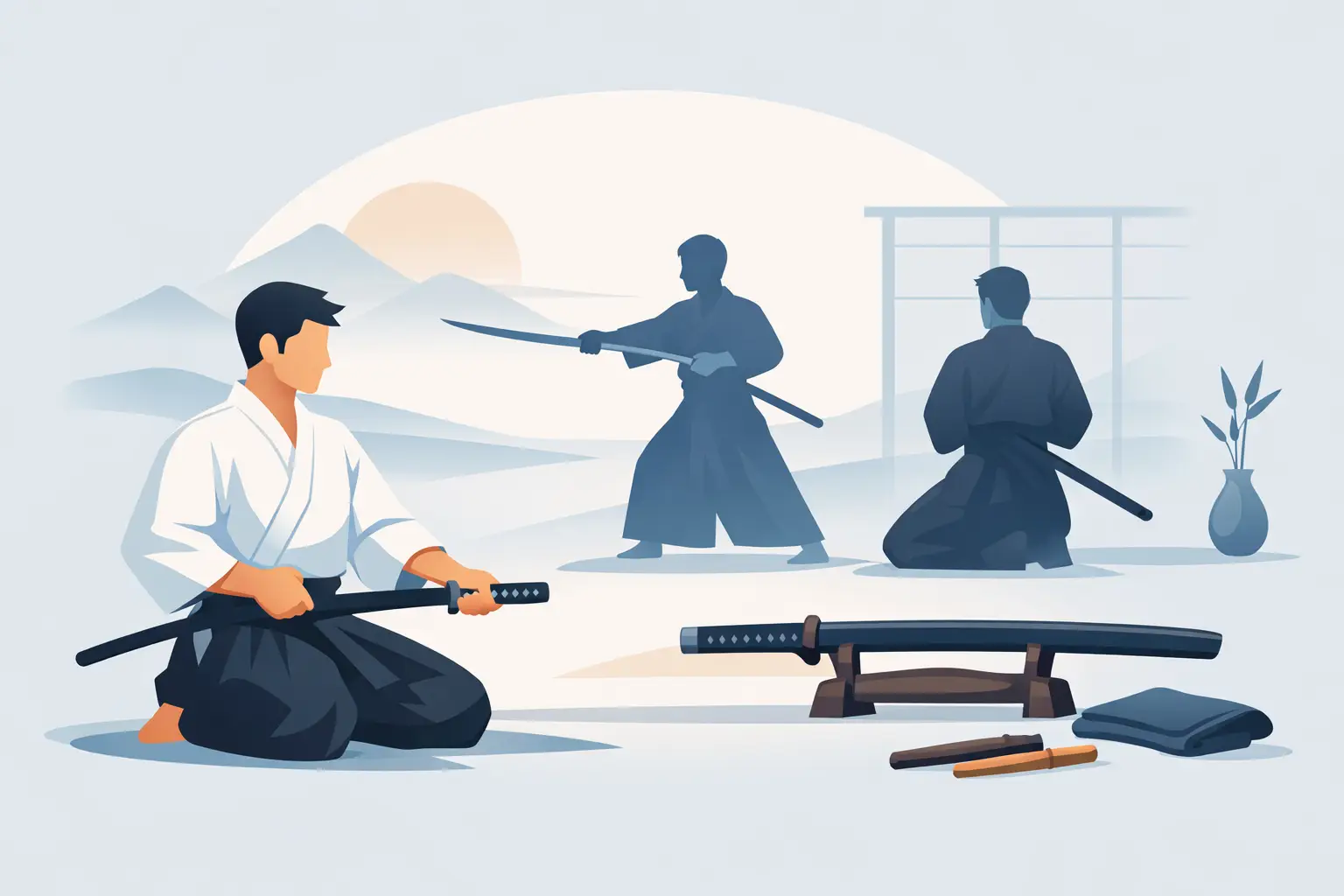
Iaido Sword Training Basics for New Students
A sword does not reward rushing. The first lesson in iaido sword training basics is that every movement begins before the blade moves: with attention, posture, and respect for the weapon in your hands. For beginners, that is good news. You do not need prior martial arts experience or athletic perfection to start. You need patience, careful instruction, and a willingness to practice the same fundamentals until they become dependable.
Iaido is a traditional Japanese martial art centered on drawing the sword, responding to an imagined threat, making a controlled cut, cleaning the blade, and returning it to the scabbard. It develops coordination and physical control, but its deeper challenge is mental. Students learn to stay calm under pressure, follow precise directions, and take responsibility for every action.
What Iaido Training Teaches From Day One
Iaido is sometimes described as the art of drawing the sword, but that description is only part of the picture. A complete technique, often practiced as a kata, follows a disciplined sequence. The student begins in a formal position, recognizes the situation represented by the kata, draws with purpose, cuts with control, performs chiburi, or symbolic blade cleaning, and returns the sword to the saya, or scabbard.
The sequence matters because it builds habits. A student cannot safely perform a fast draw without first learning where the hands belong, how the hips move, and where the blade is pointed. In a quality class, speed comes later. Clean form, awareness, and safety come first.
For teens and adults, iaido can be a powerful alternative to a screen-heavy routine. It asks you to be fully present. There is no room for distracted practice when your stance, grip, breathing, and blade position must work together.
The Essential Iaido Sword Training Basics
Start with etiquette and awareness
Before students draw a sword, they learn dojo etiquette. This includes how to enter the training space, how to bow, where to place equipment, and how to listen when an instructor gives direction. These practices are not empty ceremony. They establish a serious and supportive training environment where everyone can practice safely.
Awareness also means knowing what is around you. Students learn to maintain appropriate spacing, keep the sword directed safely, and avoid casual handling. In sword arts, discipline protects the entire class.
Build a stable posture
Iaido movements begin from the floor up. Whether standing or kneeling, the student needs a balanced base, relaxed shoulders, and a spine that stays upright without becoming stiff. Tension slows movement and makes the sword harder to control.
A beginner may be surprised by how demanding a simple stance can feel. Holding correct posture develops leg strength, hip mobility, core stability, and endurance. It also teaches a practical lesson that carries into karate, jujutsu, school, work, and daily life: calm strength is more useful than frantic effort.
Learn the correct grip
The sword is held with both hands, but the grip is not a tight squeeze. Students learn how the hands support the handle, called the tsuka, while allowing the wrists and shoulders to move naturally. Too much tension can pull a cut off line. Too little control can make the sword feel unstable.
Instructors commonly correct grip early and often because it affects nearly everything that follows. A sound grip supports better cutting mechanics, safer handling, and more consistent technique.
Practice drawing slowly
The draw, or nukitsuke, is one of iaido’s defining skills. Beginners do not begin by trying to look fast. They learn to coordinate the hand on the scabbard, the hand on the handle, the position of the hips, and the path of the blade.
The sword must clear the saya without scraping, twisting, or pointing carelessly. This takes repetition. Slow practice gives students time to notice small errors and correct them before those errors become habits. A controlled draw may look simple from the outside, but it represents focused work from the entire body.
Understand the cut before adding power
A proper sword cut is not created by swinging only with the arms. It uses posture, grip, shoulder alignment, and a clear path through the target line. Early training often focuses on cutting motions in the air, with an instructor checking alignment and control.
Students should not expect to cut targets immediately. Target cutting is a specialized practice that requires additional supervision, equipment, and proven control. It can be valuable at the right stage, but it is not the foundation of beginning iaido.
Return the sword with care
Noto, the return of the blade to the scabbard, demands the same focus as the draw. It is often one of the most challenging skills for new students because it requires precision without looking directly at the opening of the saya.
This is where patient instruction matters most. Rushing noto creates bad habits and unnecessary risk. Careful repetition builds confidence, and confidence allows students to move with control rather than hesitation.
Choosing the Right Training Sword
Beginning students should train with the equipment their instructor recommends. In many programs, students start with a wooden practice sword, called a bokken or bokuto. This allows them to learn body mechanics, footwork, and etiquette without immediately managing a metal blade.
As training progresses, students may use an iaito, an unsharpened metal practice sword designed for iaido. A live blade, or shinken, is not beginner equipment. It requires greater experience, mature judgment, and explicit instructor approval.
The right choice depends on the student’s age, experience, class curriculum, and the standards of the school. Avoid buying a decorative sword online and assuming it is suitable for training. Decorative pieces may be poorly balanced, unsafe, or made without the construction needed for martial arts practice.
Safety Rules Every Beginner Should Follow
Sword training should always be taught in person by a qualified instructor. Videos can introduce vocabulary or history, but they cannot correct distance, blade angle, posture, or unsafe habits in real time.
Beginners should treat every training sword as if it can cause harm. Keep the weapon sheathed until instructed otherwise, maintain enough space from others, inspect equipment before class, and never practice advanced draws or cutting techniques without supervision. If something feels loose, damaged, or unfamiliar, stop and ask.
Families should also understand that iaido is not about acting out sword fights. Traditional practice is structured, measured, and respectful. Students develop self-control by learning that a weapon is never a toy and skill always carries responsibility.
What a Beginner Iaido Class Usually Feels Like
A first class is often quieter than a beginner expects. There may be warm-ups to prepare the hips, legs, shoulders, and wrists, followed by basic standing positions, stepping, drawing mechanics, and simple kata instruction. Students may spend a significant amount of time practicing one detail, such as how to sit, rise, turn, or hold the sword.
That deliberate pace is a strength, not a drawback. Iaido gives students a clear path for measuring progress. At first, progress may mean remembering the order of a kata. Later, it may mean a smoother draw, better balance, cleaner timing, or the ability to stay composed after making a mistake.
Students who are used to fast-paced workouts may need time to appreciate this approach. Iaido can be physically challenging, but its rewards are built through precision rather than constant intensity. For people who want a discipline that trains both body and mind, that trade-off is often exactly what makes it worthwhile.
Building Confidence Through Consistent Practice
The biggest change many students experience is not a dramatic sword technique. It is a shift in how they carry themselves. Repeating difficult movements teaches perseverance. Receiving corrections teaches humility. Performing a kata with focus teaches confidence earned through preparation.
At Japanese Martial Arts Academy, traditional training is approached with the structure beginners need and the standards serious students respect. Iaido can complement broader martial arts training by improving posture, concentration, coordination, and disciplined movement.
Parents considering martial arts for a teen should look beyond entertainment value. A class that requires respect, attention, and steady effort can help young people build habits that matter far beyond the dojo. Adults can benefit for the same reason: disciplined practice creates a place to reset, focus, and make measurable progress.
Your first iaido class will not ask you to be perfect. It will ask you to be present, teachable, and willing to improve one careful movement at a time.