
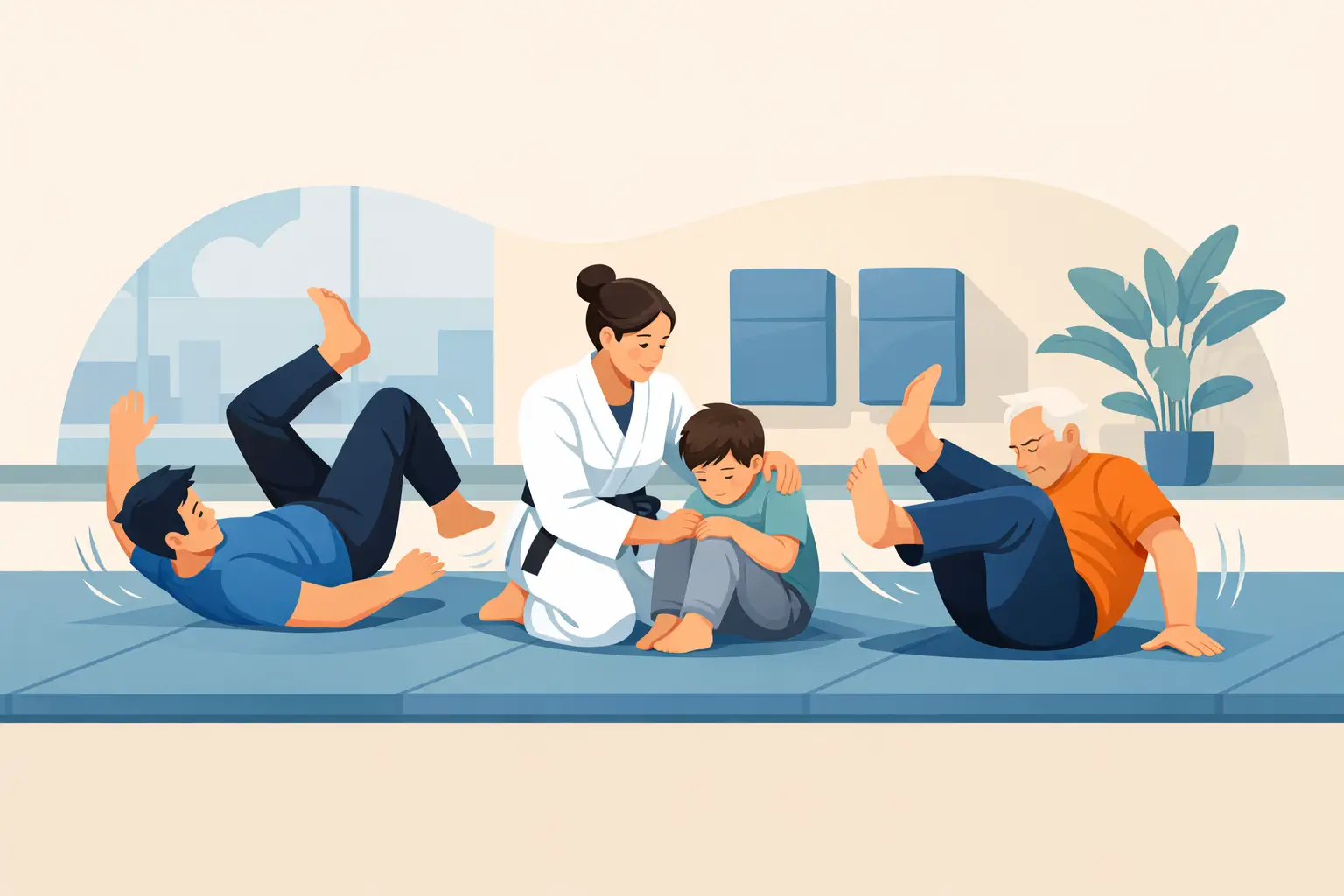
How to Practice Breakfalls Safely at Any Age
A hard fall can happen before a person has time to think. A wet driveway, a missed step, a wrestling scramble, or a self-defense situation can put someone on the ground quickly. Learning how to practice breakfalls safely gives children, teens, and adults a better chance to protect their head, manage impact, and recover with control instead of panic.
In Japanese martial arts, breakfalls are often called ukemi. They are not tricks for slamming yourself into the mat. They are disciplined movement skills built through repetition, patience, and qualified instruction. A good breakfall teaches the body to round, relax at the right moment, protect vulnerable areas, and redirect force across a larger surface.
Why Breakfalls Matter Beyond the Dojo
Breakfalls support far more than throws and takedowns. They build body awareness, balance, confidence, and the ability to stay composed when movement becomes unpredictable. For children, that may mean becoming more coordinated during play and sports. For teens and adults, it can reinforce safer habits in grappling, wrestling, jujutsu, and everyday movement.
The goal is never to become careless about falling. The goal is to respect the danger of impact while developing a trained response. Even experienced martial artists avoid unnecessary falls, assess their environment, and use good judgment. Breakfall training is one layer of personal safety, not permission to take risks.
How to Practice Breakfalls Safely: Start With the Right Conditions
Safe progress begins before the first repetition. Use clean, well-maintained martial arts mats or another surface specifically designed for impact training. Carpet, grass, mattresses, and hard floors do not provide the same consistent support or traction. A soft-looking surface can still shift, conceal hazards, or encourage poor mechanics.
Wear clothing that allows full movement without loose jewelry, watches, or items in your pockets. Warm up first. A few minutes of joint circles, light footwork, squats, and controlled hip movement can help prepare the wrists, shoulders, neck, back, and hips for training.
Most importantly, beginners should learn breakfalls under the supervision of a qualified instructor. This is especially true for children, older adults, anyone returning after an injury, and students with neck, back, shoulder, wrist, hip, or balance concerns. If pain, dizziness, numbness, or unusual discomfort appears, stop training and speak with an instructor and appropriate medical professional.
Build the Skill From the Ground Up
A common mistake is trying to learn a standing breakfall on day one. That creates fear, increases speed, and makes it harder to notice errors. Strong martial arts instruction starts close to the ground, where the student can learn positioning without the force of a full fall.
Learn the protective body shape
Begin from a seated or reclined position. Keep the chin gently tucked so the head does not snap backward. Keep the spine rounded rather than rigid, and avoid posting a straight arm behind you. A locked arm can transfer force into the wrist, elbow, or shoulder.
For a basic backward breakfall, students typically keep their arms slightly bent and angled away from the body, using the broad area of the forearms and hands to help spread impact. The exact arm position may vary by style and body type, but the principle stays the same: protect the head, avoid reaching back with a stiff arm, and distribute force rather than concentrating it in one joint.
The legs also matter. Rather than letting the heels crash heavily, students learn to control the lower body and keep it from whipping unpredictably. A qualified instructor can correct details that are easy to miss when practicing alone, such as flaring the elbows too far, lifting the chin, or striking the mat too hard.
Progress from seated to squatting
Once the movement is comfortable from the ground, practice from a seated position, then from a low squat. At each level, the student should be able to fall calmly, protect the head consistently, and stand back up under control before moving higher.
This is where discipline creates confidence. Ten careful repetitions with sound technique are more valuable than fifty rushed repetitions. Students should pause between repetitions when needed, reset their posture, and listen to feedback. Speed is earned after control, not before it.
Add direction one at a time
Backward breakfalls are only one piece of the skill. Depending on the martial art, students may also train side breakfalls and forward rolling movements. Each direction has its own mechanics, so avoid blending them into one hurried drill.
A safe forward roll is not a roll over the head or neck. It travels diagonally across the shoulder and upper back, with the head protected and the body rounded. Side breakfalls require careful attention to arm placement, hip contact, and head position. These movements should be introduced gradually, particularly for younger students whose coordination and confidence are still developing.
Use a Training Partner Only When You Are Ready
Partner practice is valuable because real falls often involve another person. It also adds variables: timing, distance, grip pressure, body weight, and momentum. That is why partnered drills come after a student has reliable solo movement.
Start with cooperative practice. The partner should guide rather than force the motion, using slow, predictable movement and releasing safely when appropriate. Both students need clear communication. If someone says stop, feels off-balance, or does not understand the drill, the practice pauses immediately.
Avoid trying advanced throws because they look exciting. A throw is only as safe as the control shown by both partners. The person applying the technique must protect their training partner throughout the motion, not simply complete the technique. At Japanese Martial Arts Academy, structured martial arts training helps students develop both sides of that responsibility: falling safely and handling a partner with respect.
Common Errors That Turn Practice Into Risk
The most frequent breakfall errors are usually caused by fear or rushing. Students may throw a hand straight behind them, lift the chin, tense every muscle, or attempt to catch themselves with one arm. These reactions are understandable, but they can increase the chance of injury.
Another error is practicing on an unsuitable surface because it feels convenient. Hard ground does not teach toughness. It often teaches students to brace, avoid full movement, or accept unnecessary impact. Good training conditions allow students to practice correct mechanics enough times for the movement to become familiar.
Parents should also be cautious about asking children to demonstrate breakfalls at home. A child may understand the drill on academy mats with an instructor nearby but forget details in a living room, on a trampoline, or outside on uneven ground. Encourage the child to explain what they learned, but save impact practice for the training space.
Make Breakfalls Part of Long-Term Training
Breakfalls improve through consistent, low-pressure practice. They fit naturally into a warm-up, a jujutsu lesson, wrestling drills, or controlled self-defense training. The purpose is not to make every class physically punishing. It is to keep the movement familiar enough that students can respond with better posture and awareness when balance is challenged.
Progress will look different for every student. A confident teen athlete may move quickly through the early stages but still need reminders about control. A younger child may need more time to coordinate the arms and chin position. An adult beginner may need to build mobility and comfort gradually. That is not falling behind. That is training intelligently.
The best first breakfall is not dramatic. It is quiet, controlled, and repeated under careful guidance. Give yourself or your child the time to build that foundation, and every future step, roll, takedown, and recovery can be approached with more confidence and composure.