
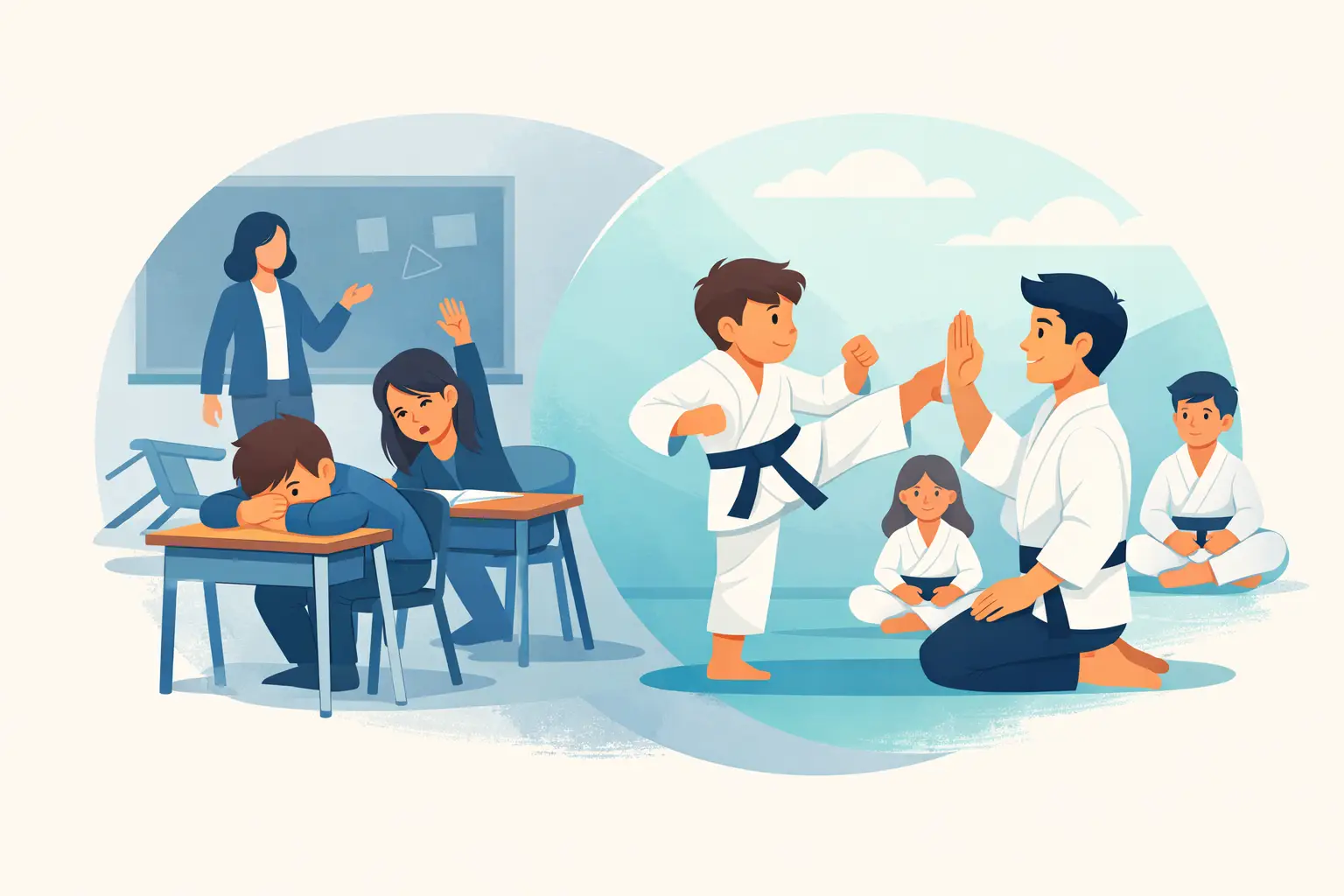
How Karate Improves Classroom Behavior at School
A child who has trouble sitting still, blurts out answers, or gives up when work gets difficult is not necessarily a child who lacks potential. Often, they need a consistent place to practice focus, self-control, and follow-through. That is how karate improves classroom behavior: it gives students clear expectations, repeatable routines, and a positive way to build confidence one class at a time.
For parents, the goal is not to turn every child into a perfect student overnight. The goal is to help them develop habits that carry from the dojo into the classroom, at home, and everywhere they are expected to make good choices.
Structure Gives Kids a Stronger Starting Point
Karate class begins with structure. Students line up, listen for instruction, show respect to their instructors and training partners, and follow a sequence of drills. They learn that progress comes from paying attention to details, practicing with purpose, and completing what they start.
Those same expectations appear in school. A student must listen when the teacher is speaking, wait for directions, stay in their assigned space, and move from one task to the next without losing control. Karate does not replace support from teachers or parents, but it reinforces the same behaviors through active, hands-on training.
Children respond well when expectations are clear and consistent. In a quality martial arts program, they know what respectful behavior looks like. They also know that effort matters. A student does not earn progress by being the loudest or strongest person in the room. They advance by showing discipline, practicing skills, and demonstrating character.
Focus Is a Skill Students Can Practice
Many children are surrounded by constant distractions. Screens, noise, busy schedules, and social pressure can make sustained attention difficult. Karate gives kids a focused task in front of them: learn a stance, remember a sequence, respond to a command, or improve one technique.
A student cannot perform a form well while thinking about five other things. They must be present. Over time, this practice helps them recognize when their attention has wandered and bring it back to the task. That is a powerful skill for spelling tests, reading assignments, group projects, and following multi-step directions.
Listening Before Moving
In karate, moving too soon often means missing the instruction. Students learn to watch, listen, and then act. This simple pattern can make a meaningful difference in the classroom, especially for children who rush through assignments or interrupt before hearing the full question.
The benefit is not instant compliance. Young students will still have difficult days, and teens may still test boundaries. But a disciplined training environment gives them a familiar reset: pause, listen, focus, and try again.
Karate Builds Self-Control Without Shaming Kids
Martial arts training teaches children that strength includes control. A student may learn powerful strikes, kicks, grappling movements, and self-defense skills, but they also learn when not to use them. They practice maintaining safe distance, controlling contact, and respecting a partner’s limits.
That lesson reaches far beyond the training floor. Self-control in class can mean keeping hands to yourself, managing frustration when a classmate disagrees, or choosing to ask for help instead of reacting in anger. Karate gives children a constructive outlet for energy while teaching that their actions have consequences.
This is especially valuable for students who feel big emotions. They do not need to be told that those emotions are wrong. They need tools to respond with more control. Training can help them breathe, reset their body, follow a routine, and direct their energy toward a productive challenge.
Confidence Changes How Students Participate
Some classroom behavior concerns are not caused by too much confidence. They come from too little. A child who is afraid of getting an answer wrong may avoid participating, shut down during challenging work, or distract others to avoid feeling embarrassed.
Karate gives students regular opportunities to face manageable challenges. They may struggle to remember a technique, hold a stance, or perform in front of others. With coaching and repetition, they improve. That experience teaches a valuable message: being new at something is not the same as being bad at it.
As students earn new skills and work toward rank goals, they begin to see themselves as capable. A confident child is often more willing to raise a hand, attempt a difficult assignment, speak respectfully, and recover after a mistake. They learn that progress is built through effort, not perfection.
Respect Becomes an Action, Not Just a Rule
Parents and teachers regularly remind children to be respectful. Karate gives that word a practical meaning. Respect is shown through eye contact, listening, proper language, care for equipment, and consideration for training partners of different ages and abilities.
In a family-centered dojo, children also train around students who may be younger, older, more experienced, or just starting out. They learn to take turns, encourage others, and accept correction without arguing. These social skills support better group work, healthier friendships, and more positive interactions with teachers.
Respect does not mean a child should never speak up. It means they learn how to communicate with control. A student can disagree, ask a question, or explain a problem without becoming disruptive or disrespectful.
Why Karate Improves Classroom Behavior Over Time
The strongest results usually come from consistent training, not a single exciting class. A child needs time to absorb the routines, build trust with instructors, and experience the connection between effort and progress. For some students, improved behavior may show up quickly as better listening and calmer transitions. For others, the early change may be quieter: they become more willing to try, more comfortable receiving feedback, or less likely to quit.
It also depends on the child and the program. A high-energy student may benefit most from physical activity and clear boundaries. A shy student may grow through supportive coaching and small wins. A teen may respond to the responsibility of helping newer students or working toward practical self-defense goals.
The best martial arts programs do not promise to solve every school challenge. Academic struggles, attention concerns, bullying, learning differences, and emotional stress may require support from families, teachers, counselors, or health professionals. Karate can be a valuable part of that support system because it gives students a dependable place to practice better habits.
What Parents Should Look For in a Martial Arts Program
Not every after-school activity creates the same environment. Parents should look for instructors who set high standards while treating students with patience and respect. Classes should be organized, age-appropriate, and built around safety, skill development, and character.
At Japanese Martial Arts Academy, students train in traditional Japanese martial arts with a clear focus on confidence, discipline, fitness, and practical self-defense. Children are challenged to grow, but beginners are welcomed and supported from their first class. The goal is not simply to teach techniques. It is to help students build habits that serve them in school, at home, and in their community.
Parents can support the connection between training and school by asking specific questions after class. Instead of only asking what technique was learned, ask when their child had to focus, how they handled a correction, or what they did when something felt difficult. Those conversations help children recognize that discipline is not limited to karate class.
A child does not have to be naturally athletic, outgoing, or perfectly behaved to benefit from karate. They only need a place where effort is noticed, standards are clear, and improvement is possible. With steady practice, the habits built on the training floor can help them walk into the classroom with more control, confidence, and readiness to learn.