
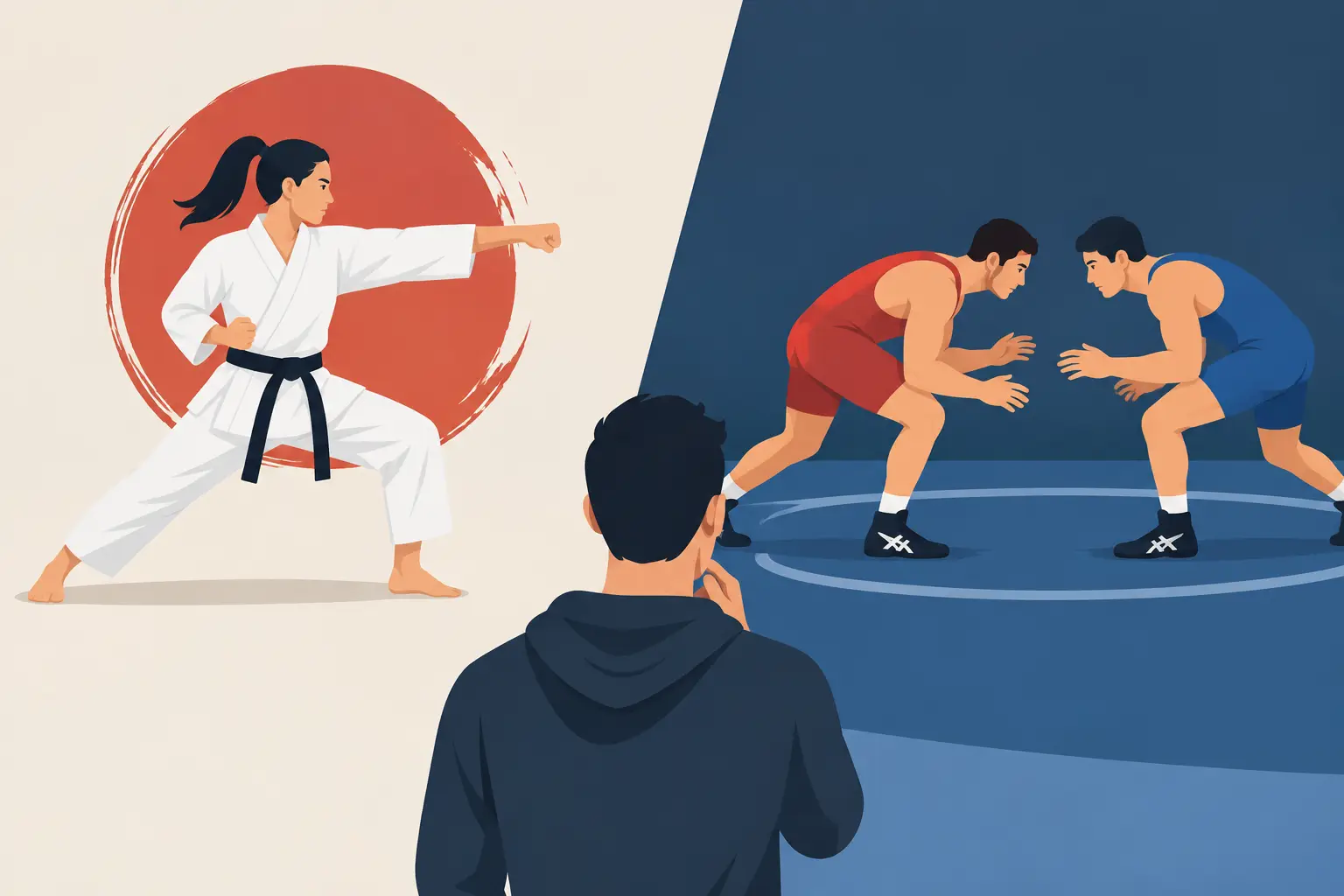
Karate Versus Wrestling Training: Which Fits You?
A child who freezes when a classmate crowds their space needs a different skill than a child who struggles to stay calm when a game becomes physical. That is why karate versus wrestling training is not simply a question of which workout looks more exciting. Each discipline develops valuable abilities, but they begin from different ranges, use different rules of engagement, and challenge students in different ways.
For families, teens, and adults in Sapulpa, the better choice depends on your goals. Do you want to build striking fundamentals, posture, focus, and controlled distance? Are you drawn to takedowns, balance, pressure, and the ability to work from the ground? Understanding the difference helps you choose training that supports real confidence instead of guessing based on stereotypes.
Karate Versus Wrestling Training: The Core Difference
Karate is primarily a stand-up martial art. Students learn how to move with purpose, create and manage distance, deliver controlled strikes, defend against incoming attacks, and maintain a strong posture under pressure. Traditional Japanese karate also places major emphasis on discipline, respectful conduct, forms, and steady technical progress.
Wrestling focuses on close-range control. Students learn stance, level changes, hand fighting, takedowns, escapes, pins, and how to use leverage rather than relying on size alone. It is physically demanding because students must solve problems while another person is actively trying to control their movement.
Neither system is automatically better. Karate develops the ability to stay composed and effective on your feet. Wrestling develops the ability to stay composed when distance disappears. For a well-rounded student, both are useful parts of a larger martial arts foundation.
What karate training builds
Karate training teaches students to recognize range. They learn when they are close enough to strike, when they need to move, and how proper footwork can prevent a problem from becoming worse. Kicks, punches, blocks, body positioning, and controlled combinations all require coordination and attention.
For children, this structure can be especially powerful. Earning ranks and improving forms gives them clear goals. They practice listening, following directions, controlling their energy, and showing respect to instructors and training partners. Those habits can carry into school, sports, and home life.
Karate is also a strong fit for adults who want an engaging way to improve mobility, coordination, conditioning, and self-defense awareness. A good class challenges the body without reducing training to random exercise. Students are building skills they can see and measure over time.
What wrestling training builds
Wrestling starts with a reality many beginners do not expect: once someone grabs you, strength alone is not enough. Good wrestlers learn to lower their center of gravity, protect their balance, control grips, and use angles to redirect force. They become comfortable working hard in close contact.
That experience builds toughness, but it should also build humility. A smaller student can often succeed through timing, position, and persistence. Students quickly learn that rushing forward without a plan creates openings, while patience and technique create control.
Wrestling can be an excellent outlet for energetic children and teens who enjoy athletic competition. It improves body awareness, endurance, grip strength, and determination. Adults benefit as well, especially those looking for a full-body challenge that requires both physical effort and quick decision-making.
Fitness Benefits: Different Demands, Real Results
Karate and wrestling both improve fitness, but they emphasize different physical qualities. Karate often develops balance, flexibility, coordination, speed, and core control. Repeated stance work and kicking drills can strengthen the legs while teaching students to move with precision.
Wrestling places a heavier demand on muscular endurance, conditioning, and total-body strength. A round of takedown drills or ground work can reveal weak links quickly. Students use their legs, hips, back, shoulders, hands, and core together, often while carrying or resisting another person’s weight.
The trade-off is simple. Students who prefer space, technique, and controlled striking may enjoy karate more at first. Students who enjoy intense physical contact and athletic problem-solving may connect with wrestling faster. A beginner does not need to arrive in great shape for either one. Consistent training is what builds fitness.
Self-Defense: Why Range Matters
Practical self-defense is not about winning a fight. It is about awareness, judgment, confidence, and making safe choices when possible. The best outcome is always to avoid danger, use a clear voice, create distance, and get help.
Karate gives students tools for the moment when they have room to move. Footwork, defensive positioning, controlled strikes, and awareness of distance can help a student avoid being trapped. It also reinforces the discipline to use force only when necessary and appropriate.
Wrestling addresses another difficult situation: what happens when someone grabs, pushes, or pulls you into close range. Learning to stay balanced, break a grip, avoid being taken down, stand back up, or control position can be extremely valuable. It can also reduce panic if a student ends up on the ground.
There are limits to both systems when practiced alone. Karate does not fully replace close-contact and ground training. Wrestling does not teach the same striking range, defensive movement, or traditional striking mechanics. That is why a dual-system approach provides a more complete foundation for students interested in practical self-defense.
Which Is Better for Kids?
For most children, the best program is the one that keeps them engaged while teaching them to become more responsible. A quiet child may thrive in karate’s clear routines, individual progress, and confidence-building structure. A high-energy child may love wrestling’s pace, physical challenge, and direct feedback.
Parents should look beyond whether their child is naturally athletic. Martial arts training is not reserved for the loudest, strongest, or most coordinated kids. The right instruction meets beginners where they are, teaches safety from the first class, and helps each student make progress at a healthy pace.
Karate can teach a child to stand tall, focus their attention, and control impulses. Wrestling can teach them to recover when things feel difficult, work through pressure, and respect the importance of position. Together, those lessons can build a child who is more confident without becoming careless or aggressive.
How to Choose Your Starting Point
Start with the goal that matters most right now. If you want traditional martial arts training, striking fundamentals, discipline, and a strong path of visible rank progression, karate may be the natural first step. If you want intense athletic conditioning, takedown skills, and confidence in close contact, wrestling may be the stronger match.
Consider personality, but do not let it make the entire decision. A student who is nervous about contact may benefit from gradually learning wrestling in a safe setting. A student who thinks karate looks easy may discover that precision, patience, and self-control are demanding skills. Growth often happens just beyond what feels familiar.
It also helps to think about the whole family. When children, teens, and parents train in a supportive community, they can encourage one another, celebrate progress, and develop healthier routines together. At Japanese Martial Arts Academy, students can experience both stand-up and ground-focused training as part of a broader path of personal development.
Training Both Creates More Complete Confidence
A student does not have to choose one discipline forever. Karate and wrestling complement each other because each exposes a gap the other can help fill. Karate teaches students to manage distance and move with intent. Wrestling teaches them what to do when space is gone.
This combination also creates a more adaptable mindset. Students learn that confidence is not pretending every situation is easy. Confidence is knowing how to stay calm, use sound technique, keep learning, and respond with control when a challenge changes.
The best first class is not a test of whether you already belong. It is a chance to find the training that helps you or your child stand stronger, move with purpose, and grow through disciplined effort.