
Goju ryu vs shotokan: Which Karate Fits You?
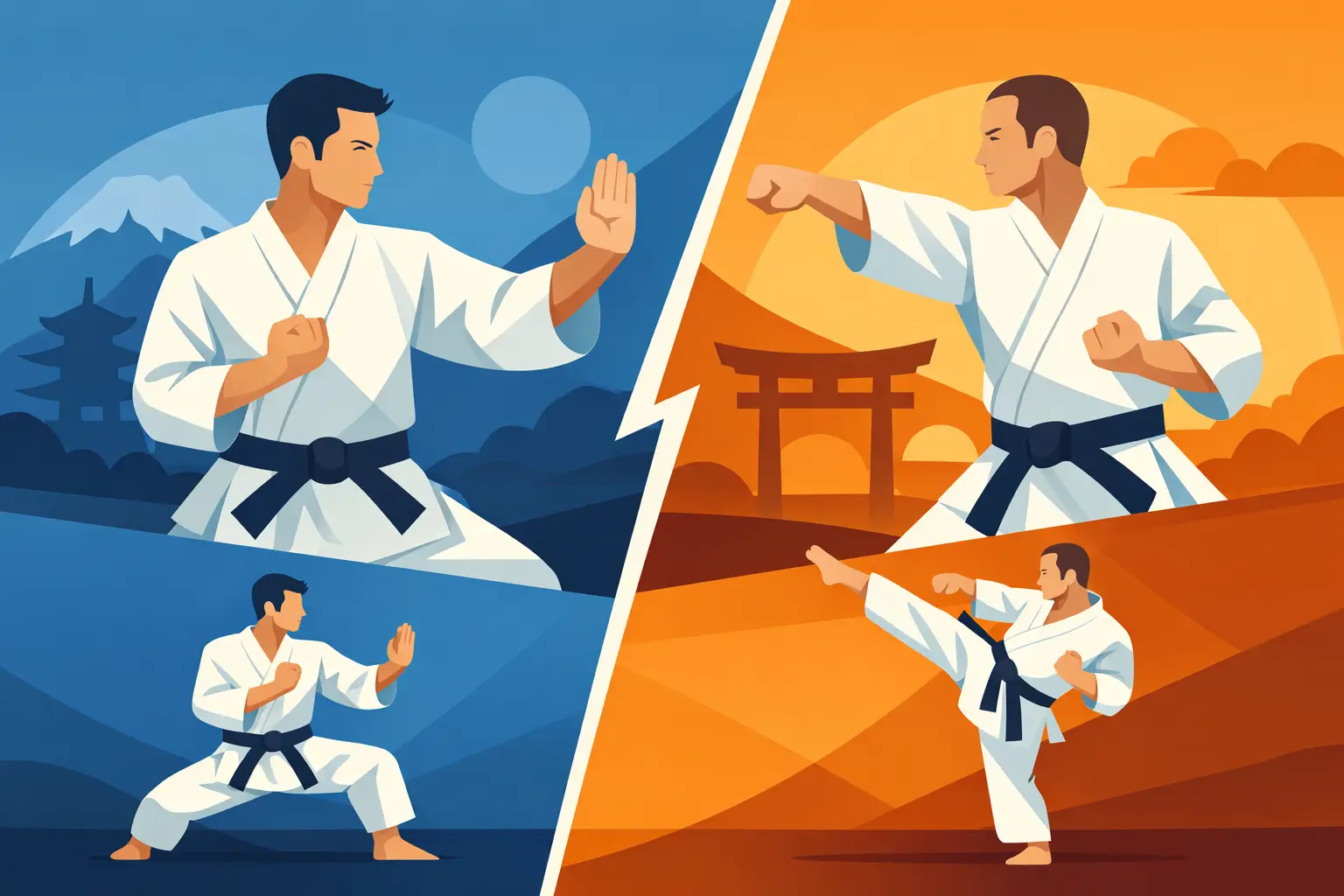
A karate stance can tell you a great deal before the first punch is thrown. One student may move with a grounded, close-range posture, ready to block, trap, and counter. Another may cover distance with a long, powerful step and fire a sharp reverse punch down the center. That contrast sits at the heart of Goju ryu vs shotokan.
Both are respected Japanese karate systems. Both can build confidence, fitness, focus, discipline, and practical striking ability. But they train those outcomes through different movement patterns, body mechanics, and fighting ranges. For parents choosing a program for a child or adults looking for a challenging path in martial arts, understanding the difference helps you choose a school and training environment that matches your goals.
Goju ryu vs shotokan: the core difference
Goju-ryu translates to “hard-soft style.” It blends powerful, direct techniques with circular blocks, close-range control, breathing training, and body conditioning. Its roots include Okinawan karate and Chinese martial arts influences, which show up in its emphasis on staying balanced under pressure and working effectively when an opponent is close.
Shotokan is known for its long stances, linear attacks, explosive movement, and strong focus on distance and timing. Students often learn to generate force by driving from the floor through the hips and finishing techniques with crisp, controlled focus. Its training can look very sharp and dynamic, especially in basics, forms, and point-style sparring.
Neither approach is automatically better. The better choice depends on what you want from training, how the instructor teaches, and whether the school gives beginners a safe, structured way to progress.
How Goju-ryu trains the body
Goju-ryu karate teaches students to combine firmness with adaptability. A hard block may become a grab, a strike, a joint-control position, or a setup for a close-range counter. Instead of relying only on retreating or trading punches at a distance, students learn to remain composed when space gets tight.
A defining part of the system is breath control. Traditional breathing exercises and forms such as Sanchin develop posture, abdominal engagement, concentration, and the ability to stay relaxed without becoming passive. For younger students, that can reinforce body awareness and self-control. For adults, it can create a demanding workout that develops functional strength instead of simply chasing fatigue.
Goju-ryu also places real value on circular motion. Blocks may redirect force instead of meeting it head-on. Strikes include punches, elbows, open-hand movements, and close-range tools that make sense when a confrontation is not clean or predictable.
This does not mean Goju-ryu is only for close quarters. Students still develop strong kicks, punches, footwork, and traditional forms. Its special strength is teaching how those skills connect when an opponent is within arm’s reach.
What Goju-ryu may suit best
Goju-ryu can be an excellent fit for students who want practical self-defense principles, whole-body conditioning, and a traditional system that rewards patience. It often appeals to families because the training has room for every stage of development. A child can work on focus, listening, coordination, and respectful conduct, while an adult can pursue fitness, stress relief, and deeper technical study.
It can also suit people who do not think of themselves as naturally athletic. Good instruction teaches stance, breathing, posture, and mechanics step by step. Progress comes from consistent effort, not from being the fastest person in the room on day one.
How Shotokan builds speed and distance
Shotokan karate is often recognized by its long, low stances and decisive line attacks. Students spend significant time developing fundamentals: how to stand, step, block, punch, kick, turn, and generate power with control. The repetitions can be demanding, but they build coordination and discipline.
Distance management is central to Shotokan. Students learn when they are safely outside an opponent’s reach, when to enter quickly, and how to leave without standing still. A well-timed lunge punch or reverse punch can be extremely effective because it uses alignment, hip rotation, and committed movement rather than arm strength alone.
Shotokan forms, called kata, are typically performed with strong lines, clear rhythm, and explosive moments. For students who enjoy precision and measurable improvement, that structure can be highly motivating. The next stance must be stronger, the next technique cleaner, the next form more confident.
What Shotokan may suit best
Shotokan may be a strong match for students who enjoy athletic movement, clear technical standards, and training that emphasizes speed, range, and explosive power. It is often a great choice for people drawn to traditional karate competition, especially forms and controlled point sparring.
For children, its clear positions and repeatable basics can be useful for building attention to detail. For teens and adults, the demanding stances and fast entries can create a serious physical challenge. Still, the quality of the school matters more than the label on the door. A supportive instructor should adjust training for age, experience, mobility, and confidence level.
Sparring and self-defense are not the same thing
This is where comparisons can become misleading. Shotokan sparring often highlights timing, distance, quick entry, and scoring a clean technique before resetting. Goju-ryu sparring may spend more time on close-range exchanges, body positioning, continuous movement, and controlling an opponent after contact is made.
Both can teach valuable lessons. Shotokan develops the ability to read range and react decisively. Goju-ryu develops comfort in crowded space, where large movements are harder to use. In a real self-defense situation, neither student should be looking for a fight. The first goal is awareness, avoidance, and getting to safety.
Effective self-defense training also needs more than punches and kicks. Students benefit from practicing verbal boundaries, situational awareness, balance recovery, safe falling, and what to do when someone grabs or tackles them. That is one reason a broader martial arts education can be so valuable. Stand-up skills are important, but ground-fighting awareness and escape skills matter too.
Which style is better for children and families?
For most children, the best style is the one taught in a well-run school with clear expectations, patient coaching, age-appropriate drills, and a positive culture. A child will not gain confidence by being thrown into hard contact before they are ready. They gain it by facing manageable challenges, earning progress, and learning that effort changes what they can do.
Goju-ryu can be especially appealing for families who want traditional karate paired with practical close-range skills and character-building structure. Shotokan can be appealing for families who value crisp fundamentals, athletic movement, and formal technical development. In either system, look for instruction that treats respect as an active skill: listening, controlling emotions, working safely with partners, and showing perseverance when training gets difficult.
At Japanese Martial Arts Academy in Sapulpa, students can build stand-up skills while also gaining exposure to a wider self-defense foundation. That combination helps families pursue more than a belt or a workout. It gives students a disciplined place to grow stronger, more focused, and more capable over time.
Questions to ask before choosing a karate class
Do not choose based only on a style name, a uniform color, or a flashy demonstration. Visit a class and watch how instructors correct students. Are beginners receiving clear guidance? Are children attentive without looking intimidated? Are students learning control alongside power?
Ask how the school approaches sparring, self-defense, forms, fitness, and advancement. If your goal is practical confidence, find out whether students train at more than one range and whether they learn how to handle grabs, pressure, and unstable positions safely. If competition is your goal, ask which events the school prepares for and how often students have opportunities to participate.
Also consider the culture. The right academy should challenge you or your child while making consistent attendance feel achievable. Martial arts results are built through months and years of training, so a welcoming community is not a small detail. It is part of what keeps students on the mat long enough to transform through disciplined training.
The right choice starts with the right training environment
Goju-ryu and Shotokan both carry valuable karate traditions. Goju-ryu tends to emphasize breathing, circular defense, conditioning, and close-range response. Shotokan tends to emphasize long-range timing, linear power, strong stances, and explosive movement. Those differences are real, but they should guide your questions, not limit your options.
The most useful next step is simple: watch a class, try the basics, and notice how the training makes you feel. A good martial arts program should leave a beginner challenged but encouraged, a parent reassured, and every student ready to return with a little more confidence than they had before.