
Karate vs Taekwondo for Kids: Which Fits Best?
A child throws their first punch or kick with a big smile, then looks to the instructor to see if they did it right. That moment says more than the style on the sign outside. When parents compare karate vs taekwondo kids programs, the best choice is usually the one that gives their child skilled instruction, clear structure, safe coaching, and a reason to come back excited next week.
Both arts can build confidence, coordination, listening skills, and respect. Both can help a child step away from screens, get active, and learn how steady effort creates progress. The differences matter, though, especially when you want training that supports practical self-defense and long-term character development.
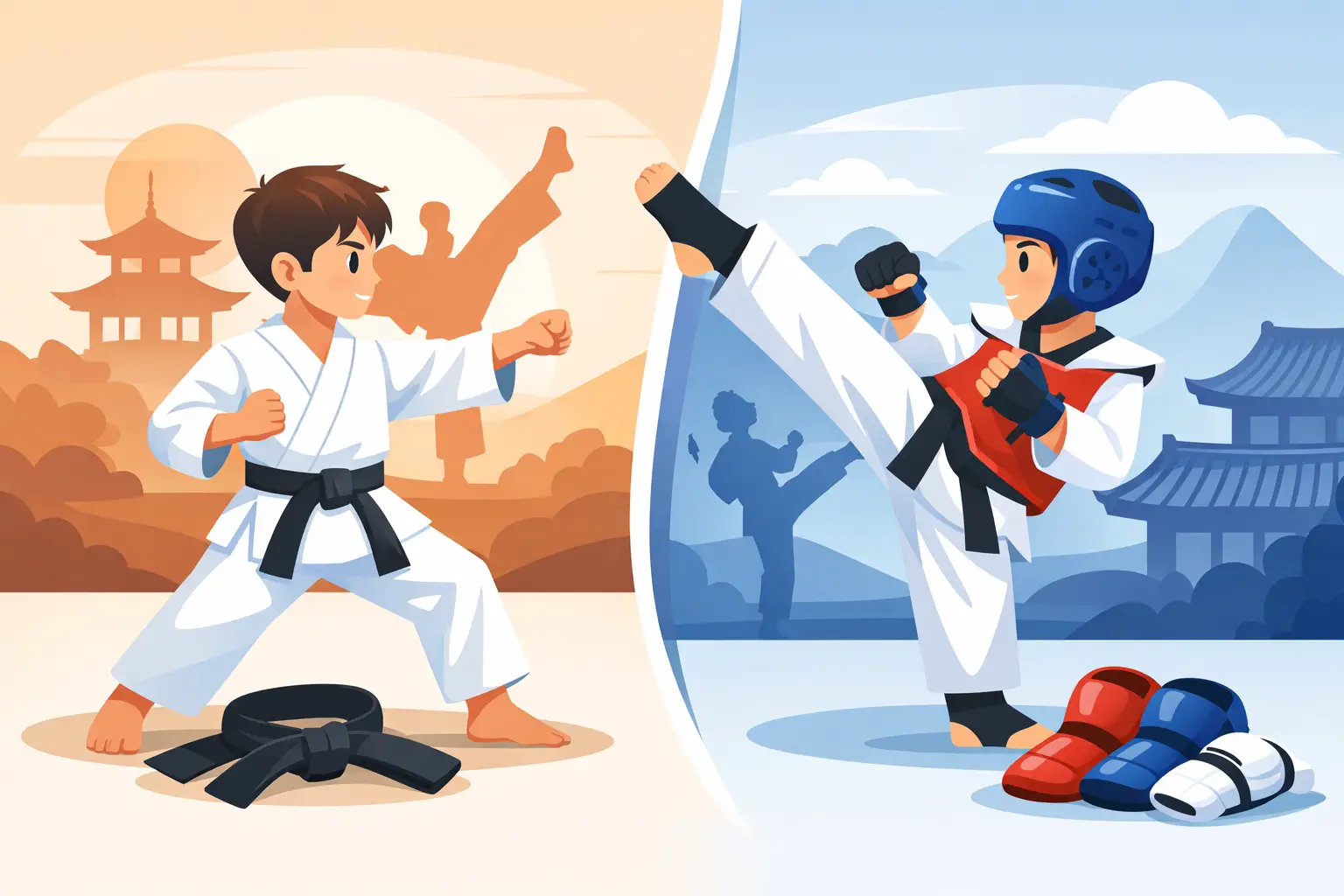
Karate vs Taekwondo for Kids: The Main Difference
Karate is a Japanese martial art best known for its balanced use of punches, kicks, blocks, stances, and close-range defensive skills. Traditional karate instruction often places strong emphasis on body control, discipline, forms, and learning how to generate power with efficient movement.
Taekwondo comes from Korea and is especially recognized for its fast, dynamic kicking techniques. Children may enjoy its high-energy movement, jumping kicks, and athletic challenge. Many taekwondo programs also include forms, sparring, rank advancement, and strong expectations for courtesy and self-control.
The simple version is this: karate tends to offer a more evenly balanced striking foundation, while taekwondo usually places more attention on kicking range, speed, and flexibility. Neither approach is automatically better for every child. The quality of the school, the instructor’s standards, and the culture of the class make a major difference.
What Kids Learn in Karate
A well-run karate class gives children more than a collection of punches. They learn to stand with purpose, keep their hands up, move with balance, and respond to instruction even when a drill is challenging. Those habits carry into school, sports, and home life.
Karate training typically develops both upper- and lower-body techniques from the beginning. A child might practice a front kick, a straight punch, a basic block, and a controlled stance in the same class. That variety can be valuable for young beginners because it builds coordination across the whole body rather than relying heavily on flexibility or flashy movement early on.
Traditional karate also uses forms, often called kata. These structured movement patterns teach focus, memory, rhythm, and technical precision. For a child who benefits from routine and clear goals, kata can become a powerful confidence-builder. They can see their improvement each time they perform the sequence with stronger posture and sharper technique.
For families focused on self-defense, karate’s emphasis on awareness, distance, blocking, and direct counterattacks can be especially appealing. Real self-defense for children is not about looking for a fight. It is about recognizing trouble, using a confident voice, creating space, getting away, and knowing basic protective movements if they cannot avoid contact.
What Kids Learn in Taekwondo
Taekwondo can be an excellent fit for a child who loves movement, enjoys a fast pace, or wants a physical challenge that feels athletic. Kicking is central to the art, so students commonly work on flexibility, balance, timing, and footwork. They may practice front kicks, round kicks, side kicks, and eventually more advanced jumping or spinning techniques.
That kick-focused training can be highly motivating. A child who has trouble sitting still may thrive when class gives them a productive place to move, sweat, and concentrate their energy. Taekwondo also develops leg strength and body awareness, which can support performance in other activities such as soccer, dance, gymnastics, or track.
Like karate, taekwondo has a rank system and forms that reward consistent effort. Students learn respect for instructors and classmates, follow rules, and work toward specific goals. A good taekwondo school keeps the excitement of high-energy techniques grounded in control. Children should never be pushed into kicks beyond their physical readiness or encouraged to sacrifice balance for height.
One consideration for parents is that taekwondo’s specialty is kicking at longer range. That is a real strength, but it is not the entire self-defense picture. If a child’s program focuses almost exclusively on kicks, families may want to ask how students learn to handle close distance, grabs, falls, and personal safety situations.
Which Style Is Better for Confidence and Discipline?
Both can build confidence, but confidence does not come from earning a belt alone. It comes from doing difficult things correctly, receiving honest coaching, and realizing that improvement is earned through practice. A child gains real confidence when they learn they can listen, keep trying, and perform under pressure without giving up.
Karate may suit children who respond well to detailed instruction, structured routines, and a broad technical foundation. The clear stances, hand techniques, and forms give many children a strong sense of order. It can be a particularly good match for parents looking for traditional training that reinforces focus and self-control.
Taekwondo may suit children who are motivated by speed, movement, and exciting kicking skills. It can help energetic kids channel their enthusiasm into disciplined action. The key is finding a program where instructors expect attention and respect, not just nonstop activity.
For either style, watch a class before enrolling. Are children treated with patience and high standards? Does the instructor correct technique without embarrassing students? Are stronger or older students encouraged to help beginners? A safe, encouraging culture will do more for a child’s confidence than a particular kick or uniform color.
The Self-Defense Question Parents Should Ask
Parents often search for martial arts because they want their child to be safer and more confident. That is a wise goal, but it helps to look beyond the label of karate or taekwondo.
Ask whether the program teaches practical safety skills for a child’s age. Young students should learn awareness, boundaries, verbal assertiveness, and when to get help from a trusted adult. As they mature, they can add controlled striking, escapes, balance-breaking, and realistic ways to create distance.
A comprehensive program should also recognize that problems do not always happen at kicking range. Children and teens may need to understand what to do if someone grabs clothing, crowds them, pushes them, or takes them to the ground. Stand-up skills are essential, but ground-fighting awareness can make training more complete.
At Japanese Martial Arts Academy, children can develop a traditional Japanese karate base while benefiting from a broader approach to personal protection. Combining stand-up training with ground-fighting skills gives families a more complete path than a single-discipline focus alone.
How to Choose the Right Class for Your Child
Start with your child’s personality, not just their favorite action movie. A quieter child may benefit from the calm structure of karate, yet they might also come alive in the active rhythm of taekwondo. An energetic child may love fast kicks, but they may need the steadiness and close attention to detail found in a traditional karate setting.
Consider the class environment as carefully as the style. Look for age-appropriate groups, instructors who can hold attention without yelling, clean training areas, and clear safety rules for partner drills. Sparring should be controlled and supervised, with safety gear and expectations that match the student’s age and experience.
Also ask what progress looks like beyond belts. A strong academy can tell you how it helps children improve focus, respect, resilience, fitness, and self-control. Belt promotions should represent consistent effort and skill development, not simply time spent enrolled.
A trial class is often the clearest answer. Your child does not need to be naturally athletic or outgoing to begin. They only need a willingness to learn. Watch how they walk out of class: tired in a good way, proud of what they tried, and ready to return.
The Best Choice Is the One They Will Practice
Karate and taekwondo both offer meaningful benefits for children. Karate often provides a balanced foundation of hand techniques, kicks, blocks, and traditional discipline. Taekwondo offers energetic kicking, athletic movement, and a powerful outlet for active kids. The right answer depends on your child and on the standards of the school leading them.
Choose a program that challenges your child while helping them feel supported. When they are taught to stand tall, listen closely, treat others with respect, and keep going after a mistake, martial arts becomes more than an after-school activity. It becomes a place where they can grow stronger for every part of life.