
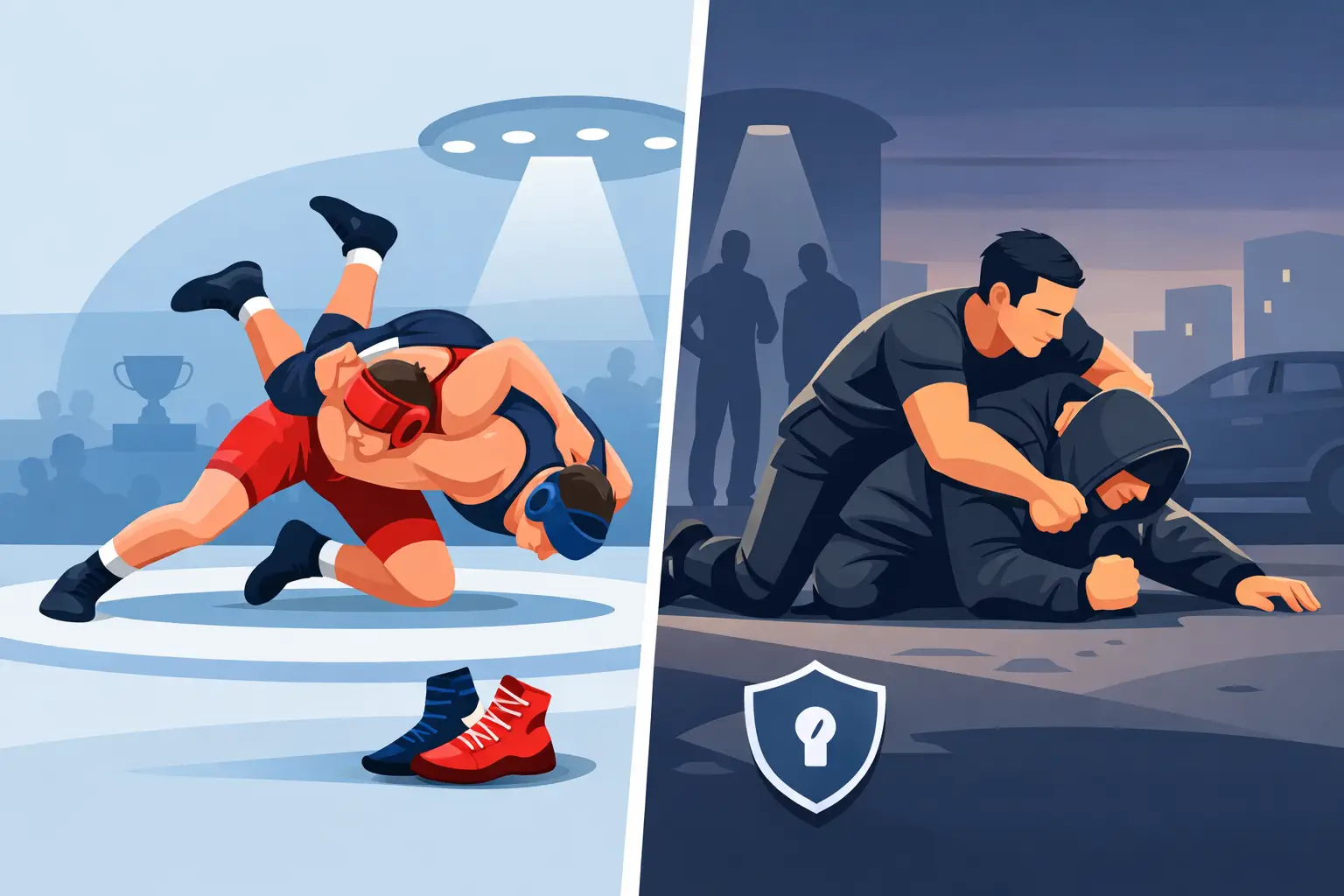
Is Wrestling for Self Defense Worth Learning?
A confrontation does not always begin with a punch. It may start with someone grabbing a sleeve, crowding personal space, forcing a clinch, or driving forward with their full body weight. In those close-range moments, wrestling for self defense can give a student a major advantage: the ability to stay balanced, control the other person, and create a safe chance to get away.
For families, teens, and adults, that practical control matters. Wrestling develops a calm response under pressure instead of panic. It teaches students how to use position, leverage, movement, and body awareness rather than relying only on strength or hoping a single strike ends the situation.
What Wrestling for Self Defense Actually Teaches
Wrestling is often associated with competition, mats, and takedowns. Those are valuable parts of training, but the self-defense benefit runs deeper. A quality wrestling program teaches students what to do when distance disappears.
Students learn how to maintain a stable stance, move their feet, control an opponent’s arms and upper body, defend against being taken down, and recover if they do hit the ground. They also learn how quickly balance can change when another person grabs, pushes, pulls, or drives into them.
That knowledge is useful because many real-world confrontations become physical at close range. A person may try to grab, tackle, restrain, or shove rather than throw a clean punch. Wrestling gives students a foundation for dealing with that pressure without freezing.
The goal is not to win a match on the sidewalk. The goal is to protect yourself, avoid unnecessary harm, break contact when possible, and leave the area safely.
Why Balance and Position Matter More Than Strength
A stronger person can be difficult to manage, but strength is not the only factor in a physical encounter. Good wrestling training teaches a student to keep their base under them, lower their center of gravity, and avoid reaching or leaning into dangerous positions.
A student who understands balance is harder to push over. A student who knows how to frame, move, and turn can often prevent a grab from becoming a full takedown. These skills are especially meaningful for smaller students, young people, and adults who do not want self-defense training to depend on size alone.
Position also determines what options are available. If someone has you pinned against a wall, wrapped around your waist, or pressing down from above, throwing random strikes may not be realistic. First, you need space and control. Wrestling teaches students to recognize bad positions and work toward safer ones.
This is one reason disciplined training is different from watching a few techniques online. Timing, posture, and pressure must be practiced with a resisting partner under qualified supervision. The body needs repetitions before it can respond with confidence.
The Self-Defense Skills Wrestling Builds
Wrestling develops practical abilities that carry over well beyond the training room. Students build coordination and conditioning, but they also develop decision-making during fast, uncomfortable exchanges.
A strong program commonly helps students improve four essential areas:
- Takedown defense: Learning how to sprawl, maintain balance, and avoid being driven to the ground.
- Clinch control: Understanding how to manage grips, underhooks, head position, and body pressure at close range.
- Ground movement: Learning how to escape poor positions, protect the head, and work back toward standing.
- Composure under pressure: Practicing against resistance so surprise and contact do not immediately lead to panic.
For a child or teen, these lessons can also improve confidence in everyday situations. They learn to stand with purpose, respect boundaries, and understand that self-control is a strength. For adults, wrestling offers a demanding way to crush fitness goals while gaining skills that have real-world value.
Where Wrestling Has Limits in Self Defense
Wrestling is highly effective, but it is not a complete answer by itself. A self-defense situation may involve punches, kicks, multiple people, hard surfaces, weapons, or obstacles. Going to the ground voluntarily can be a serious risk outside a controlled training environment.
That is why the best use of wrestling for self defense is often defensive: stay on your feet, control the immediate threat, create separation, and exit. If you are forced to the ground, wrestling experience can help you protect yourself, escape, and stand back up. It should not encourage anyone to stay engaged longer than necessary.
Students also need stand-up skills. Distance management, awareness, verbal de-escalation, and basic striking defense all matter. A person who can only wrestle may struggle before the clinch begins. A person who can only strike may struggle once an aggressor grabs hold.
The most practical approach combines both ranges of combat. Stand-up training helps a student manage distance and defend against strikes. Wrestling and ground fighting help them respond when a situation becomes close, physical, and difficult to separate from.
A Dual-System Approach Builds Better Preparedness
At Japanese Martial Arts Academy, students can train across complementary disciplines rather than being limited to one narrow skill set. Japanese Goju-ryu Karate develops striking, movement, discipline, and awareness. Wrestling adds takedown defense, clinch control, and ground skills. Japanese Jujutsu brings another layer of throws, joint control, escapes, and self-defense application.
This combination helps students understand a simple truth: self-defense does not happen at one perfect distance. A confrontation can change from verbal tension to a shove, from a shove to a grab, or from a grab to the ground in seconds. Training for more than one range gives students more options.
For beginners, this does not mean they need to know everything immediately. Progress starts with fundamentals. A new student learns safe falling, posture, movement, and basic control before advancing to more complex drills. With consistent practice, those fundamentals become dependable habits.
Is Wrestling a Good Choice for Children?
For children, wrestling can be an outstanding tool for healthy development when it is taught in a structured, encouraging environment. It gives energetic kids a productive outlet while teaching them how to follow direction, respect training partners, and handle challenges without quitting.
The physical side is clear. Children improve coordination, body control, balance, and fitness. Just as valuable are the character lessons. Wrestling requires students to stay composed when a drill is difficult, reset after a mistake, and treat partners with respect. Those habits support confidence at school, at home, and in social settings.
Parents should look for instruction that emphasizes safety, age-appropriate technique, and supervision. Young students do not need harsh training to become capable. They need clear standards, positive coaching, and a community where effort is recognized.
Training Safely and Responsibly
Self-defense training should make students more responsible, not more reckless. The first priority in any threatening situation is awareness and avoidance. If a student can leave, get help, use their voice, or de-escalate safely, those choices are usually better than physical contact.
When physical action cannot be avoided, the response should be proportionate to the danger and focused on getting safe. Wrestling gives students tools to control and escape, but every situation is different. Students should understand that training techniques must be used with judgment, respect for the law, and concern for everyone’s safety.
The training environment matters, too. Good wrestling instruction includes warm-ups, controlled partner drills, clean mats, clear rules, and coaches who teach students to tap, stop, and communicate. Confidence grows fastest when students can train hard without feeling unsafe.
A capable student is not the person looking for a fight. It is the person with enough discipline to avoid one whenever possible and enough training to act decisively if there is no safe alternative. For families looking to build that kind of confidence, a free week of structured training can be the first step toward stronger habits on and off the mat.