
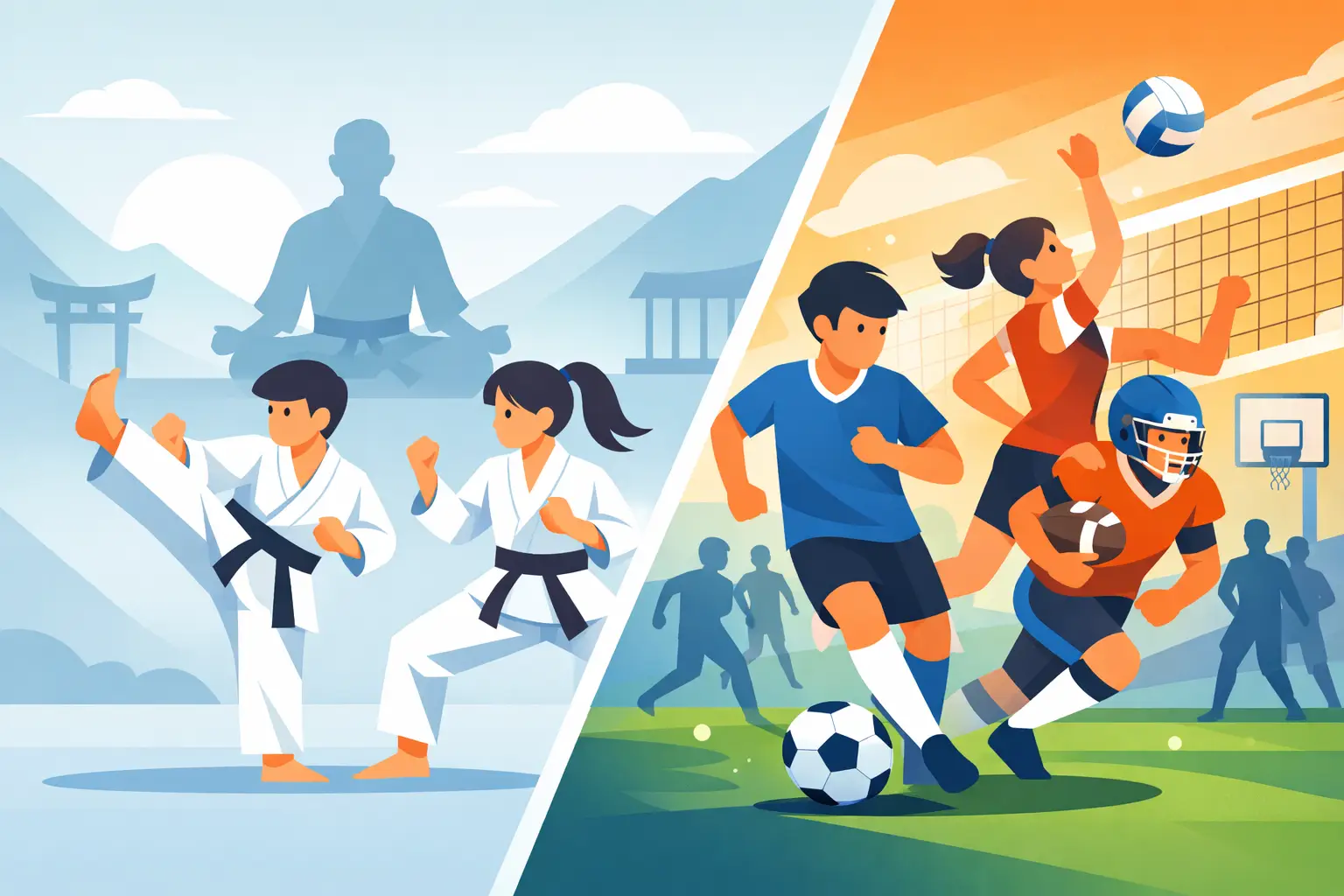
Karate Versus Team Sports: Which Builds More?
The car ride home after practice tells parents a lot. One child may be energized after scoring a goal with friends. Another may be standing taller after earning a new stripe, finally landing a technique, or pushing through a difficult drill. When considering karate versus team sports, the best choice is not always about which activity is better. It is about which environment will help your child, teen, or family member grow with confidence.
Team sports and martial arts both create meaningful opportunities for fitness, friendships, and personal development. They simply develop those benefits in different ways. Karate gives students a structured path of individual progress within a supportive group. Team sports teach cooperation, shared responsibility, and how to perform when others depend on you. For many families, the right answer may even be both.
Karate Versus Team Sports: The Core Difference
The biggest difference is where responsibility lives. In team sports, every player contributes to a shared result. A great pass, a defensive stop, or encouragement from the bench can change the outcome for everyone. Students learn to communicate, follow a game plan, support teammates, and handle both victories and losses as a group.
Karate places the student directly in front of their own effort. No teammate can complete a form, improve a stance, earn a belt, or practice self-control on someone else’s behalf. In a well-run dojo, students train alongside peers and receive constant support, but their progress is personal. That responsibility can be especially powerful for children who need to see that consistent effort leads to visible improvement.
Neither model is automatically right for every child. A highly social child may thrive on the energy of a team. A child who feels overlooked in crowded practices may find their voice in karate, where progress is measured by effort, skill, and character rather than playing time. The goal is to choose an activity that challenges the student without making them feel invisible.
Confidence That Does Not Depend on the Scoreboard
Team sports can build confidence through contribution. A child learns that they can help the group succeed, whether they are the leading scorer or the teammate who keeps showing up, hustling, and encouraging others. That is a valuable lesson, particularly when coaches make room for every player to develop.
Karate builds confidence through repeated proof. Students face a drill that feels awkward, work through corrections, and eventually perform it with control. They may begin as beginners who avoid eye contact or hesitate to speak. Over time, they learn to stand with better posture, answer clearly, make decisions under pressure, and keep going after a mistake.
This confidence is not about teaching children that they will always win a fight or never feel nervous. It is about helping them know they can stay composed, listen, and act with discipline when something is hard. Belt advancement gives students concrete milestones, but the deeper win is the resilience they carry into school, friendships, and family life.
Fitness: Different Demands, Strong Results
Both choices can get students moving far more than another hour with a screen. Team sports often develop endurance, speed, agility, and sport-specific coordination. Soccer demands constant movement and field awareness. Basketball develops quick transitions and explosive footwork. Wrestling builds strength, conditioning, and grit in a direct one-on-one setting.
Karate training can be equally demanding, with a different balance of skills. Students build coordination through stances, strikes, blocks, kicks, forms, partner drills, and controlled conditioning. They develop flexibility, balance, body awareness, and the ability to generate power with proper mechanics rather than wild movement. A comprehensive martial arts program can also introduce stand-up defense and ground-fighting principles, giving students a broader understanding of how their bodies work in close-range situations.
The best fitness activity is the one a student will attend consistently. A child who loves baseball but dreads karate should play baseball. A teen who has stopped enjoying the pressure of tryouts may rediscover motivation through martial arts. Interest matters because disciplined training only works when students return week after week.
The Social Question: Is Karate Less Social?
Parents sometimes assume team sports are social and karate is solitary. That is only partly true. Team sports create natural friendships because teammates spend long practices, games, travel, and celebrations together. Students learn how to cooperate with different personalities, resolve frustration, and put the group ahead of themselves.
Karate also creates community, but it does not rely on a roster or a season. Students train with people of different ages and experience levels, learn to respect partners, and see advanced students model patience and leadership. They may pair up for drills, encourage classmates during testing, and celebrate one another’s milestones. For families, a dojo can become a steady community that remains in place year-round rather than changing with each season.
This setting can be a strong fit for children who want friends but do not enjoy the noise or competition of large team environments. It can also help confident, athletic kids practice humility. In martial arts, there is always another technique to refine and another standard of discipline to meet.
Competition, Pressure, and Healthy Perspective
Competition is not a problem. It can teach students to prepare, focus, and perform under pressure. Team sports make competition highly visible through standings, scores, starting positions, and playoffs. Some children find that exciting. Others begin to tie their sense of worth to the scoreboard or their amount of playing time.
Karate can include tournaments, sparring, and demonstrations, but it does not have to be competition-centered. Students can set personal goals: improve a kick, memorize a form, earn a belt, lead warmups, or show more control during partner work. That makes martial arts accessible to students who want a challenge without needing every class to produce a winner and loser.
At the same time, karate is not an easy option. Students must accept correction, repeat fundamentals, maintain focus, and show respect even when they are tired. The discipline is real. The difference is that the central opponent is often yesterday’s version of yourself.
Practical Skills Beyond Practice
A major advantage of karate is that its lessons transfer directly to personal safety and daily conduct. Students learn awareness, distance, boundaries, controlled responses, and when to seek help. Responsible martial arts instruction emphasizes avoiding conflict whenever possible. Physical techniques are taught alongside judgment, self-control, and respect.
Team sports teach practical life skills too. Athletes learn to take direction, manage schedules, cope with disappointment, and stay committed to a group. These lessons can carry into school, work, and relationships for years.
For families looking for self-defense education, however, karate has a clear advantage. A student can use improved awareness and confidence long after a particular sports season ends. Training becomes a personal skill set, not only a role on a team.
How to Choose for Your Child or Family
Start by looking at temperament, not just talent. Does your child light up around teammates and game-day excitement? Do they need a place to burn energy, practice communication, and feel part of a group effort? A team sport may be a strong choice.
If your child needs more structure, individual recognition, confidence, or help with focus and self-control, karate may provide the clearer path. Martial arts can also be an excellent fit for teens and adults who want practical fitness without being selected for a team or waiting for a new season to begin.
Schedule and family logistics matter too. Team sports can involve changing practice times, weekend games, travel, and seasonal gaps. Martial arts often offers a more consistent training routine and can serve multiple family members at once. At Japanese Martial Arts Academy, families can train in traditional Japanese systems while building skills that support fitness, character, and practical self-defense.
There is no need to frame karate and team sports as rivals. A young athlete may play soccer in the fall and train in karate year-round. A wrestler may use karate to sharpen balance, discipline, and body control. A student who does not enjoy organized sports may find the structured challenge they need on the dojo floor. Choose the place where your family member is willing to work hard, be coached, and keep growing. That is where confidence takes root.