
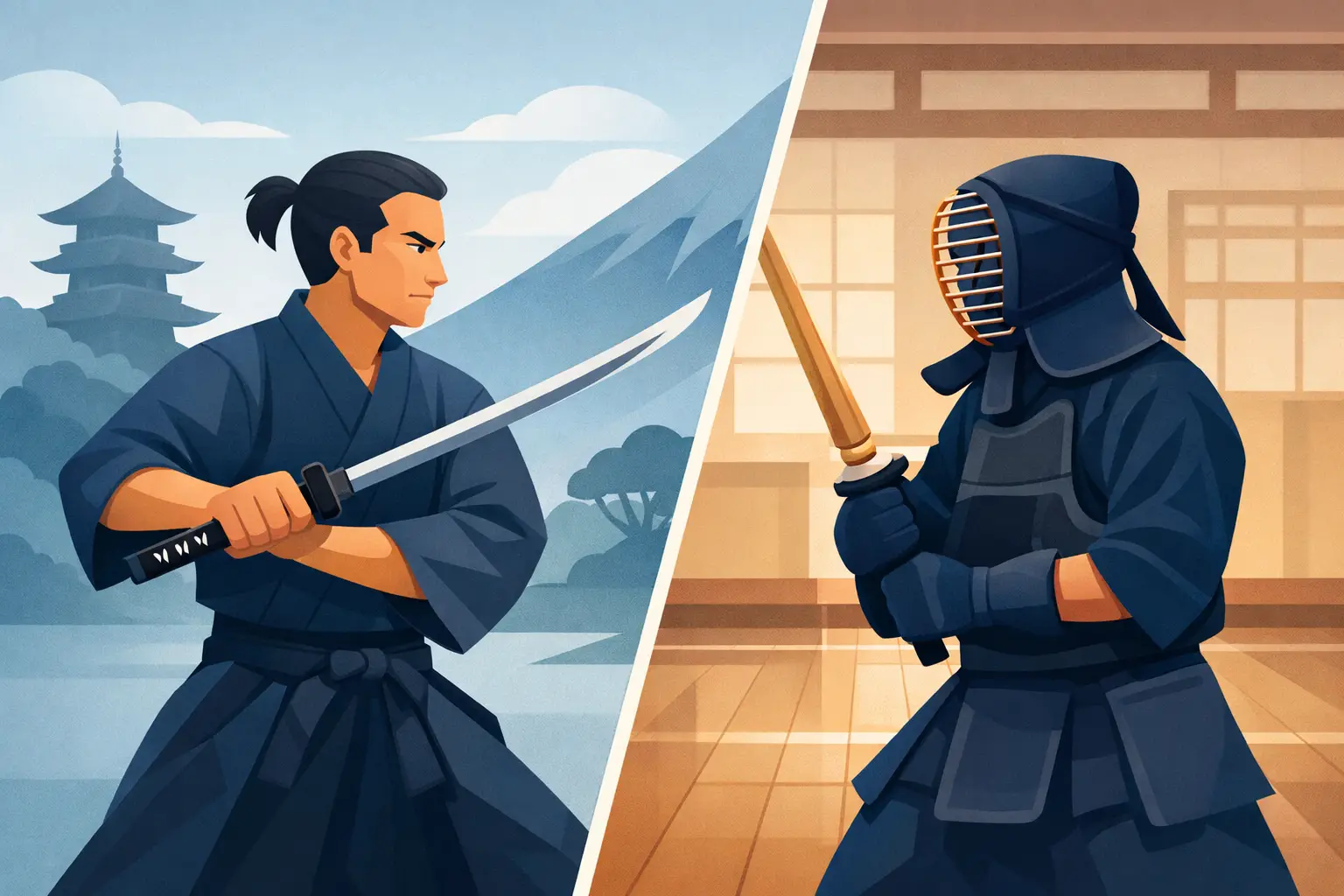
Kenjutsu vs Kendo Differences for New Students
A bamboo sword cracks against an opponent’s armor in kendo. In kenjutsu, a student may move through a precise paired form, learning the distance, timing, and decisions behind a traditional sword encounter. Both are Japanese sword arts, both demand discipline, and both can build confidence. But the kenjutsu vs kendo differences matter when choosing the right training path for yourself or your child.
The best choice is not about which art is “better.” It is about what kind of student you are, what you want from training, and whether you are drawn to competitive sparring, traditional weapon study, or a combination of physical conditioning and personal growth.
Kenjutsu vs Kendo Differences at a Glance
Kenjutsu is a broad term for traditional Japanese sword techniques. It refers to combat systems developed by historical warrior schools, often called ryu, to teach the use of the Japanese sword. Training commonly includes solo forms, paired drills, drawing and cutting concepts, footwork, distance, and the tactical choices that shape a sword encounter.
Kendo means “the way of the sword.” It is a modern Japanese martial art built around structured sparring with protective equipment and bamboo practice swords called shinai. Students score points by delivering clean, controlled strikes to designated target areas while showing proper posture, spirit, timing, and follow-through.
The simplest distinction is this: kenjutsu focuses on preserving and studying traditional sword-fighting systems, while kendo uses a modern ruleset to develop skill through live, armored practice. There is overlap in their respect for Japanese sword culture, but their methods and daily training experience can feel very different.
Purpose: Historical Application vs. Modern Competition
Kenjutsu training is often rooted in kata, which are rehearsed sequences performed alone or with a partner. Kata are not simply choreographed routines. They teach students how to recognize an opening, manage range, control the center line, and act with commitment. A well-taught form also carries an important lesson: a sword is not a toy. Every movement requires control, awareness, and respect.
Because kenjutsu comes from older combat traditions, it may include techniques that would not be appropriate for modern sporting competition. The exact curriculum varies by school and lineage. Some programs emphasize wooden sword forms, some focus on paired applications, and others may connect sword work to related arts such as iaido.
Kendo has a different training purpose. It takes sword principles and tests them in a safer competitive environment. A kendo student learns to face an active partner who is trying to create openings, disrupt timing, and score first. That pressure teaches composure. It also teaches students that good technique is not just knowing what to do – it is being able to do it when someone is moving, resisting, and responding.
For teens and adults who enjoy measurable progress, tournaments, and energetic sparring, kendo can be highly motivating. For students who are fascinated by traditional Japanese sword systems and detailed forms, kenjutsu may feel more meaningful. It depends on the school’s instruction and the student’s goals.
Equipment and Safety in Each Art
The equipment creates one of the most visible differences. Kenjutsu students often train with a bokken, a wooden practice sword, or a padded training weapon designed for specific drills. Since many exercises involve close partner work and precise targets, students must learn responsibility from the first class. Good instruction sets clear boundaries for spacing, control, attention, and respectful handling of training weapons.
Kendo students use a shinai and wear protective armor called bogu. The armor protects the head, wrists, torso, and throat area during supervised sparring. Students usually spend time building fundamentals before they participate in more active exchanges. They learn stance, footwork, basic strikes, etiquette, and how to strike with control.
Neither art should be treated casually. Safety is not an afterthought in Japanese sword training. It is part of the discipline. A quality instructor does more than hand a student a weapon. They teach awareness, emotional control, listening skills, and the responsibility that comes with training around others.
That is especially important for children. The right program does not encourage reckless swinging or fantasy play. It gives young students a structured place to channel their interest, follow direction, and build confidence through earned progress.
How Training Feels on the Floor
Kenjutsu often feels deliberate and detail-driven. Students may repeat the same sequence many times, adjusting grip, posture, angle, breathing, and timing until the movement becomes cleaner. Partner forms require both people to stay alert and cooperate with purpose. One student learns to attack correctly; the other learns to respond correctly. Over time, students begin to understand why each position exists.
This can be an excellent fit for students who enjoy focus and precision. It is also valuable for adults looking for a disciplined alternative to a standard workout. The training develops coordination, mobility, body awareness, and concentration without relying only on high-intensity exercise.
Kendo often feels faster and more physically demanding once students reach sparring practice. Footwork is active, attacks are committed, and the pace can be demanding. Students learn to keep moving even when tired, make decisions under pressure, and recover quickly from mistakes.
That does not make kendo less traditional or kenjutsu less athletic. Both require serious effort. The difference is where the effort is concentrated. Kenjutsu frequently emphasizes technical study and controlled application. Kendo places greater emphasis on applying selected techniques against a live opponent within a defined ruleset.
Which Sword Art Is Better for Children?
For a child, the answer should begin with maturity, instructor quality, and class structure – not simply the name of the art. Some children thrive with the active pace and clear scoring of kendo. Others respond better to the quiet concentration and structured forms of kenjutsu.
Parents should look for a class that teaches more than sword movements. Does the instructor expect students to stand with respect, listen on the first instruction, encourage training partners, and correct mistakes without giving up? Those habits carry into school, home, and other activities.
At Japanese Martial Arts Academy, traditional martial arts training is approached as a path for building stronger students, not just teaching techniques. A child who learns to control a practice weapon, maintain focus, and work safely with a partner is developing self-control that reaches far beyond the mat.
For families, it can also help to consider schedule and long-term interest. A child who is excited by Japanese history and careful technical learning may stay engaged in kenjutsu for years. A child who loves movement, challenge, and the thrill of testing skills may be drawn toward kendo-style sparring. A trial class and a conversation with an experienced instructor can reveal much more than an online description.
Can Kenjutsu and Kendo Complement Each Other?
Yes, with the right instruction. Kenjutsu can give a student deeper context for distance, posture, lines of attack, and traditional sword principles. Kendo can sharpen timing, conditioning, courage, and the ability to apply technique under pressure. Each exposes a different side of sword training.
Still, students should avoid assuming that skills transfer perfectly from one system to the other. A technique that makes sense in a historical kenjutsu form may not be legal or practical under kendo competition rules. Likewise, a successful kendo scoring action may not represent the full tactical situation explored in a traditional kata. Respecting each art on its own terms leads to better training.
Choosing a Program With Confidence
When comparing kenjutsu vs kendo differences, ask what the class actually teaches week after week. Find out whether beginners receive clear safety instruction, whether the program is age-appropriate, and whether the instructor can explain the purpose behind the drills. Look for a school where students are challenged, supported, and expected to grow.
A Japanese sword art should leave students with more than a new skill. The right training environment helps them stand taller, focus longer, respond with discipline, and take pride in steady progress. Start with the path that keeps you eager to return to class, then let consistent practice shape the confidence you carry everywhere else.