
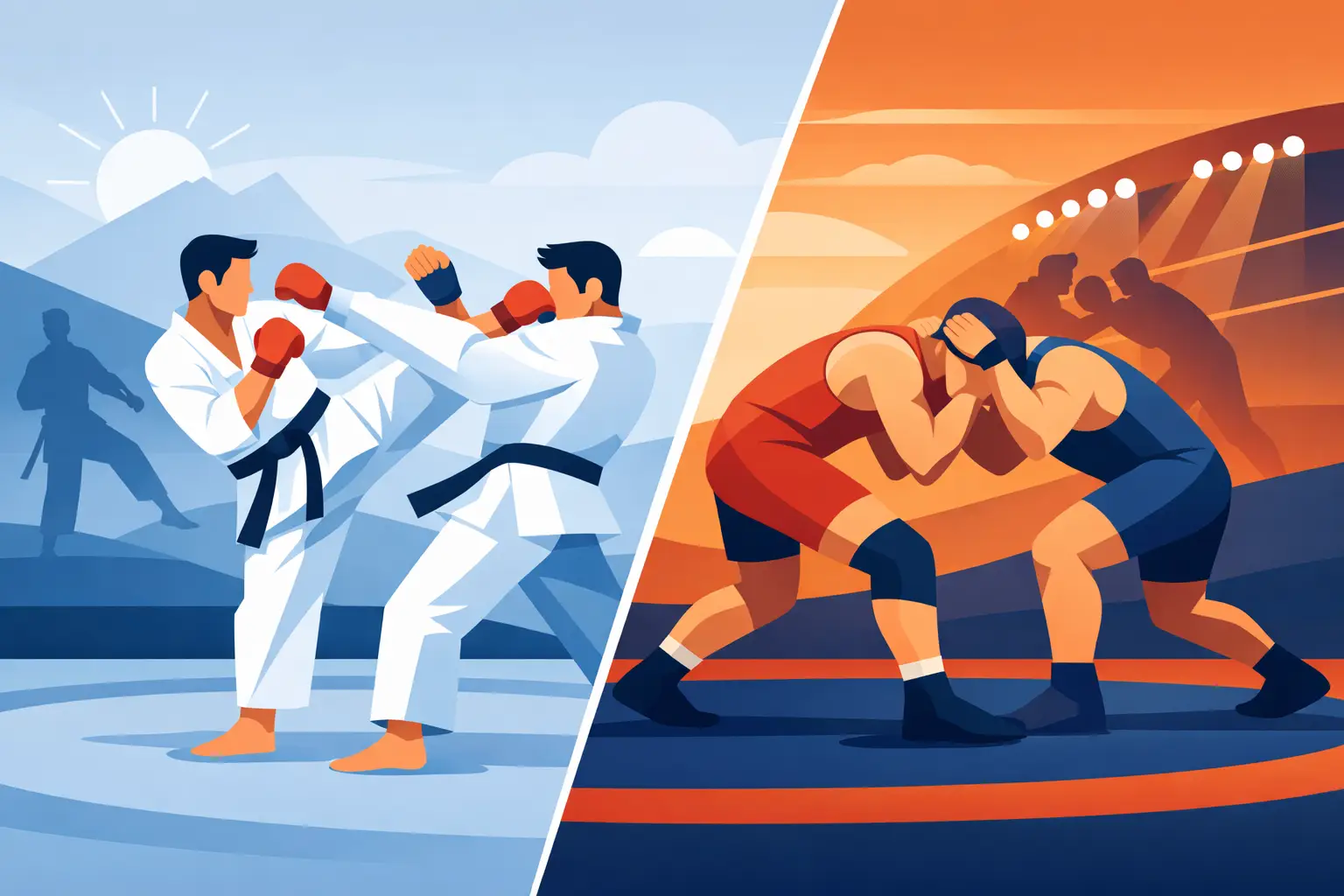
Karate or Wrestling Fitness: Which Fits You?
Some workouts leave you tired. The right training leaves you stronger, sharper, and more confident the next time you walk into class. That is the real question behind karate or wrestling fitness. It is not just about burning calories. It is about choosing a training path that builds usable strength, discipline, and momentum you can feel in daily life.
For families, teens, and adults, that choice can feel bigger than it sounds. Karate and wrestling both demand effort, focus, and consistency. Both can improve conditioning. Both can challenge beginners in the best way. But they develop the body in different patterns, and they shape confidence in different ways too.
Karate or Wrestling Fitness: What Changes in Your Body?
Karate fitness is built around posture, balance, striking mechanics, footwork, core control, and repeated movement with precision. A strong karate class does more than make you sweat. It trains you to move with intention. Students develop leg strength from stances, hip power from strikes, endurance from drills, and coordination from combinations that require the whole body to work together.
Wrestling fitness has a different feel. It is close-range, pressure-heavy, and physically demanding in a very direct way. Wrestling develops grip strength, neck strength, explosive power, body control, and the kind of conditioning that comes from resisting another person who is trying to move you off your base. It is one of the most honest workouts you can do because it exposes weak links quickly.
If you are comparing the two strictly on effort, neither is easy. Karate often surprises beginners who assume it is mostly technique. Wrestling often surprises beginners who underestimate how technical it really is. In both cases, fitness improves because the training has purpose. You are not just exercising. You are solving movement problems under instruction.
How Karate Fitness Builds Athletic Ability
Karate is an excellent choice for students who want to improve speed, mobility, coordination, and body awareness while also learning practical self-defense principles. Because training includes striking, stance work, partner drills, and forms, students build fitness through repetition that has structure and progression.
For children, that matters. Many kids do not need more random activity. They need disciplined movement with clear expectations. Karate helps them learn how to stand correctly, listen carefully, control impulses, and generate power without chaos. That physical control often carries over into better focus at school and better self-control at home.
For adults, karate can be a smart long-term fitness path because it balances challenge with skill development. You are not relying only on brute force. You are learning timing, distance, mechanics, and precision. That makes the training sustainable for many people who want strong conditioning without feeling like every class is a grind session.
Karate also rewards consistent effort in a visible way. A student who practices stance, technique, and movement starts to look different when they move. Posture improves. Reactions get quicker. Confidence grows because progress is earned, not guessed at.
Where karate has the edge
Karate tends to be especially strong for students who want stand-up self-defense skills, improved coordination, and a disciplined environment that supports mental growth as much as physical fitness. It can also be a great fit for families because children, teens, and adults can all train within a structured system that respects age and development.
That said, karate fitness is not magic. If someone wants constant body-to-body resistance and a heavy emphasis on takedowns, clinch pressure, and scrambling, karate alone may not satisfy that goal.
How Wrestling Fitness Builds Toughness and Conditioning
Wrestling is one of the fastest ways to build real-world athletic conditioning. It asks a lot from the lungs, the legs, the back, and the mind. During wrestling practice, students sprawl, shoot, pummel, drive, resist, recover, and repeat. The result is a level of functional fitness that carries over well into many sports and self-defense situations.
Wrestling also teaches composure under pressure. There is no hiding when someone is trying to control your position. Students learn leverage, balance, pressure, and persistence. That kind of training develops grit because every round demands problem-solving while fatigued.
For teens and adults who want to get stronger and tougher in a practical sense, wrestling is extremely effective. It builds explosive entries, strong hips, durable posture, and the ability to keep working when a situation gets uncomfortable. For children, wrestling can be outstanding when taught in a safe, structured environment with strong coaching. It channels energy into disciplined effort and teaches respect for rules, partners, and technique.
Where wrestling has the edge
Wrestling often has the advantage for students who want intense conditioning, close-contact control skills, and stronger ground awareness. It is especially useful for building resilience and physical confidence in tight spaces.
The trade-off is that wrestling can feel demanding very quickly for complete beginners. Some students love that challenge right away. Others do better when they can build confidence through stand-up technique first and add grappling as they grow.
Karate or Wrestling Fitness for Weight Loss and General Health
If your first goal is weight loss, either style can help, but success depends on consistency more than labels. A student who attends karate classes regularly and trains with focus will improve conditioning and burn calories. A student who commits to wrestling will likely see rapid gains in work capacity and muscular endurance. The better option is usually the one you will stick with.
This is where enjoyment matters more than people admit. If you dread the class format, your motivation fades. If you enjoy the structure, the challenge, and the sense of progress, you keep coming back. That is how real fitness changes happen.
There is also a difference between getting tired and becoming healthier. Good martial arts training improves more than the scale. It can strengthen joints through controlled movement, improve balance, increase coordination, sharpen mental focus, and reduce the boredom that makes many exercise programs fail after a few weeks.
Which Is Better for Kids, Teens, and Adults?
For kids, karate is often the easier entry point because it offers clear structure, personal space, and a visible path of progress. It is excellent for confidence, listening skills, discipline, and controlled movement. Wrestling can also be great for kids, especially those who thrive on active physical challenge, but it usually requires a comfort level with contact that some children need time to build.
For teens, it depends on personality and goals. A teen who wants explosive conditioning and enjoys competition may connect strongly with wrestling. A teen who wants a balanced path of self-defense, focus, and physical development may prefer karate. Some teens benefit most from both because stand-up and ground skills complement each other.
For adults, the decision often comes down to injuries, comfort level, and training purpose. If someone wants striking, posture, mobility, and structured technical progression, karate makes a lot of sense. If they want pressure-tested grappling fitness and close-range control, wrestling may be the better fit. Many adults discover that a dual approach gives them the most complete result.
Why Combined Training Often Wins
The strongest answer to karate or wrestling fitness is sometimes not one or the other. It is both.
Stand-up skill and ground skill are not competing needs in real self-defense or complete physical development. They support each other. Karate helps students develop distance management, striking mechanics, timing, and disciplined movement. Wrestling adds takedown defense, balance under pressure, control, and the ability to work through resistance at close range.
That combination also creates a more complete athlete. You build agility and precision from striking practice, then add strength, grit, and body control from grappling. For many students, this leads to faster overall growth because each training method exposes different weaknesses and develops different strengths.
At Japanese Martial Arts Academy, that balanced approach is part of what makes training so valuable for families and individuals who want more than a basic workout. Students can build confidence through disciplined training while developing skills that matter both on the feet and on the ground.
How to Choose the Right Fit
If you are choosing for yourself or your child, start with the real goal. If the goal is confidence, focus, and structured skill-building, karate may be the best first step. If the goal is intense conditioning, close-contact toughness, and ground control, wrestling may be the better match. If the goal is complete development, the best path may include both over time.
Do not underestimate the value of environment either. A great instructor and a strong school culture can make either style more effective. Students improve faster when they feel challenged, supported, and safe enough to learn. Parents notice the difference quickly when a program teaches respect and discipline instead of just running kids in circles.
The best training choice is the one that keeps you showing up, keeps you growing, and keeps building skills you can carry for life. When fitness comes through disciplined martial arts practice, it stops feeling like a chore and starts becoming part of who you are.